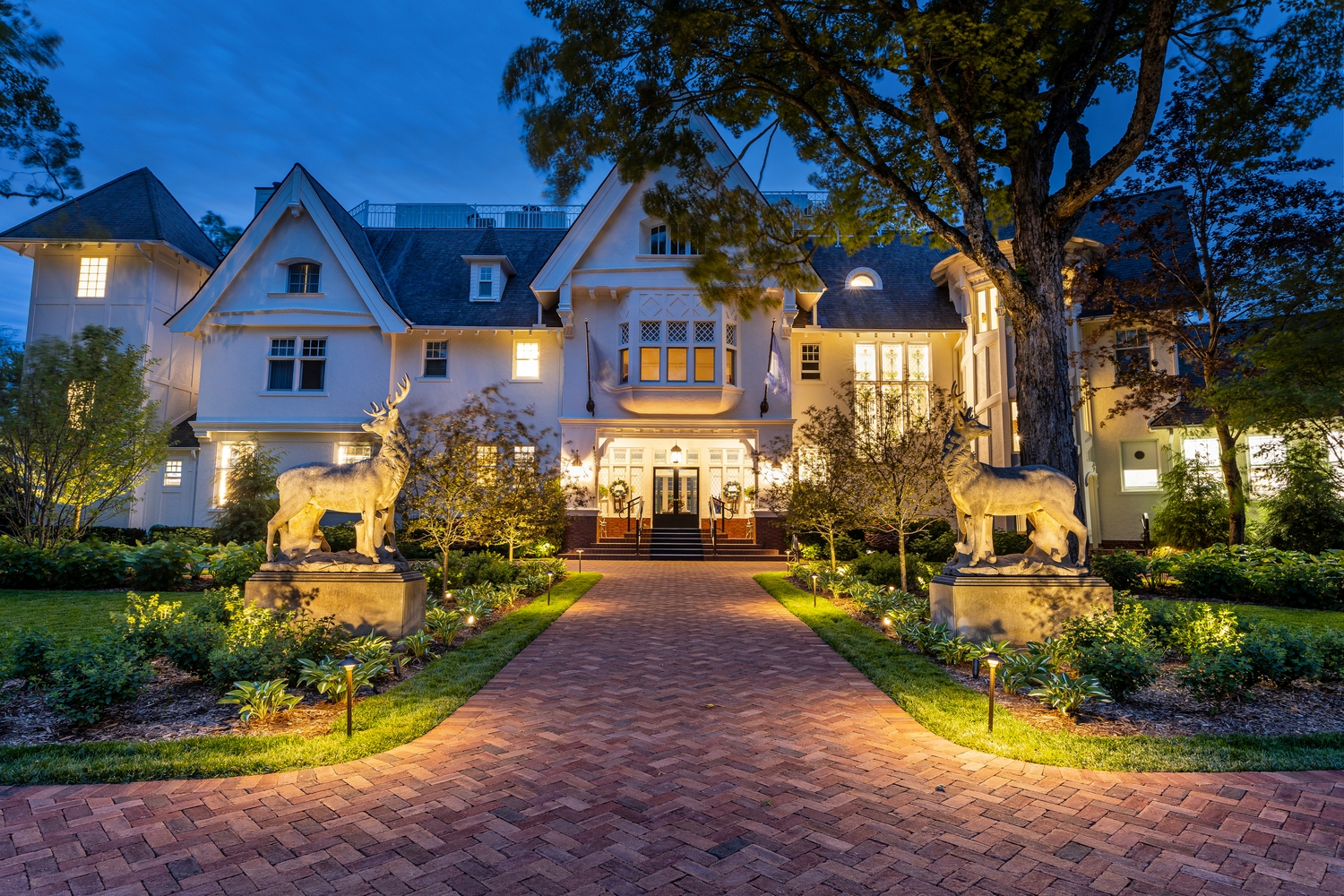
Who Owns The Inn at Stonecliffe?
The Inn at Stonecliffe is owned by the Pulte Family Charitable Foundation, a private family foundation that operates select properties as Humanitarian Hotels. Unlike traditional luxury resorts, 100 percent of Stonecliffe’s net profits support charitable and educational initiatives, making every stay part of a larger, purpose-driven system.
This ownership model shapes everything guests experience — from the pace of the property and its restoration philosophy to its long-term stewardship and sense of calm. Stonecliffe is not designed for rapid turnover, speculative ownership, or trend-driven reinvention. It is designed to endure.
What follows is not a marketing story, but an ownership story — one that explains why Stonecliffe feels different, why its luxury is quieter, and why its impact extends far beyond Mackinac Island.
A Story of Stewardship, Purpose, and a Different Kind of Luxury
There are places that exist to be admired.
And then there are places that exist to mean something.
Perched quietly on Mackinac Island’s West Bluff, The Inn at Stonecliffe belongs firmly to the latter. From the moment guests arrive, there is an unmistakable sense that this is not simply a luxury resort restored for comfort and beauty alone. It is a place shaped by intention. A place stewarded, not exploited. A place where the experience feels grounded in something deeper than trend or transaction.
That feeling is not accidental. It begins with ownership.
Quick Answer: Who Owns The Inn at Stonecliffe?
The Inn at Stonecliffe is owned by the Pulte Family Charitable Foundation, a private family foundation that operates select properties as Humanitarian Hotels. Through this model, 100 percent of net profits generated by The Inn at Stonecliffe are directed toward charitable and educational initiatives, transforming hospitality into a quiet but powerful engine for good.
This ownership structure makes Stonecliffe fundamentally different from nearly every other luxury hotel on Mackinac Island, and in the Midwest.
But the deeper story goes far beyond a single sentence.
Ownership as Stewardship, Not Transaction
In the modern hospitality world, ownership is often invisible. Resorts are assets. Destinations are inventory. History is a marketing angle.
Stonecliffe resists that model entirely.
The property’s current owners did not acquire The Inn at Stonecliffe to chase seasonal returns or short-term prestige. They took on the responsibility of restoring and reopening a historic estate with a long view in mind: preservation, dignity of place, and lasting impact well beyond the island’s shoreline.
To understand Stonecliffe today, you must understand that its ownership is rooted in stewardship rather than speculation.
Stewardship means:
-
Preserving architectural and cultural heritage rather than erasing it
-
Investing patiently, even when returns are slower
-
Designing guest experiences that feel intentional, not excessive
-
Viewing hospitality as a service, not simply a product
This philosophy shapes everything from the pace of the property to the tone of the guest experience. It also explains why Stonecliffe feels simultaneously refined and grounded, elevated yet unpretentious.
A Luxury Hotel With a Different Purpose
Luxury hospitality often defines itself through what it offers: views, amenities, exclusivity, access.
Stonecliffe defines itself through what it enables.
Every stay at The Inn at Stonecliffe quietly supports initiatives far beyond Mackinac Island. Not through add-on fees. Not through marketing campaigns. Not through limited-time charitable partnerships.
But through ownership itself.
Because Stonecliffe is part of a portfolio of Humanitarian Hotels, its success directly fuels philanthropic work. Rooms fund education. Weddings help support housing. Retreats contribute to care for those who need it most.
Guests may come for the views of Lake Huron, the restored estate architecture, the privacy of the West Bluff, or the tranquility of an island without cars. Many leave with the sense that their stay was part of something larger, even if that realization comes only after the fact.
That subtlety is intentional.
Stonecliffe does not ask guests to perform generosity. It simply allows generosity to happen quietly, in the background, through thoughtful ownership.
Why Ownership Matters More Than Ever in Hospitality
Travelers today are asking deeper questions:
-
Who owns the places I stay?
-
Where does my money ultimately go?
-
What values shape the experience I’m supporting?
These questions are no longer niche. They are increasingly central to how luxury travelers choose destinations, venues, and brands they trust.
Ownership shapes:
-
How properties are renovated
-
How staff are supported
-
How communities are engaged
-
How success is defined
At Stonecliffe, ownership answers those questions with unusual clarity.
The Inn is not owned by a multinational hospitality conglomerate.
It is not governed by quarterly earnings calls.
It is not optimized for maximum turnover.
Instead, it is stewarded by a family foundation whose work spans education, housing, human dignity, and long-term community investment.
Stonecliffe’s luxury, therefore, is not just aesthetic. It is philosophical.
A Place Where Legacy Is Preserved, Not Repurposed
Stonecliffe’s history stretches back more than a century, and its recent restoration reflects an uncommon respect for that past. Rather than overwriting the estate’s character, the renovation honored its scale, its siting, and its sense of refuge above the straits.
This approach mirrors the ownership philosophy behind it.
Preservation over reinvention.
Meaning over momentum.
Longevity over novelty.
The result is a property that feels timeless rather than trendy — a place that does not chase attention, but earns loyalty.
The Beginning of a Larger Story
To understand who owns The Inn at Stonecliffe is to begin understanding why it exists in the form it does today.
In the sections that follow, this story expands outward:
-
Into the origins and mission of the Pulte Family Charitable Foundation
-
Into the concept of Humanitarian Hotels and how hospitality can fund lasting impact
-
Into the specific initiatives supported through Stonecliffe’s success
-
And into what this ownership model means for guests, couples, retreat planners, and communities alike
The story of Stonecliffe is not simply about ownership.
It is about purpose expressed through place.
And it is only just beginning.
What Is the Pulte Family Charitable Foundation?
To understand the ownership of The Inn at Stonecliffe fully, it is necessary to step back from the island and look at the broader institution responsible for its stewardship.
The Pulte Family Charitable Foundation is a private family foundation established to direct long-term resources toward work that strengthens human dignity, expands opportunity, and supports communities often overlooked by traditional systems. Its scope is national. Its approach is intentionally quiet. And its influence reaches far beyond any single property or initiative.
Unlike many philanthropic organizations that operate primarily as grant distributors, the Foundation is structured around active stewardship. It does not simply fund projects; it helps shape them, sustain them, and, where possible, ensure their permanence.
This distinction matters — particularly in understanding why the Foundation chose to own and operate hospitality properties like Stonecliffe.
A Foundation Built for Long-Term Impact
The Pulte Family Charitable Foundation operates with a long horizon.
Its work is designed around:
-
Multi-decade outcomes rather than annual metrics
-
Enduring institutions rather than temporary programs
-
Sustainable systems rather than one-time interventions
This long-term orientation informs everything from the Foundation’s capital structure to its partnerships. It also explains why hospitality — traditionally a short-cycle, seasonal industry — plays a role in its mission.
Stonecliffe is not an outlier within the Foundation’s portfolio. It is a deliberate expression of a belief that well-run, values-aligned enterprises can fund human good at scale.
Why Hospitality Became Part of the Mission
At first glance, luxury hotels and charitable foundations may appear to exist in separate worlds.
But for the Pulte Family Charitable Foundation, hospitality offered something unique:
a renewable source of revenue that could be aligned with care, excellence, and service.
Hotels, when stewarded thoughtfully, create:
-
Jobs that support families
-
Places that bring people together
-
Experiences that foster rest, celebration, and reflection
-
Revenue streams capable of sustaining charitable work year after year
Rather than relying solely on donations or endowment returns, the Foundation embraced hospitality as a self-renewing engine — one that could quietly fund education, housing, and care without requiring guests to opt in or opt out of generosity.
This belief would eventually give rise to the concept of Humanitarian Hotels.
Humanitarian Hotels: A Quietly Radical Model
The Humanitarian Hotels model is simple in concept, but rare in practice.
Properties owned by the Pulte Family Charitable Foundation are operated as full-service, high-standard hotels. They compete in the luxury and upper-upscale market on experience, design, and service — not on messaging.
The difference lies beneath the surface.
After operating expenses and reinvestment needs are met, net profits are directed entirely toward charitable and educational initiatives supported by the Foundation.
There are no donation prompts at check-in.
No cause-branded packages required to participate.
No marketing campaigns asking guests to give more.
The act of staying is enough.
This model allows generosity to remain dignified, hospitality to remain pure, and impact to scale quietly over time.
Stonecliffe is one of these Humanitarian Hotels — and its success on Mackinac Island has made it a powerful contributor to the Foundation’s broader work.
The Foundation’s Areas of Focus
While the Foundation’s initiatives span multiple regions and disciplines, its work consistently centers on a small number of core human needs. These focus areas form the philosophical backbone of its giving and provide context for how Stonecliffe’s success is ultimately translated into impact.
Education as a Pathway to Possibility
The Foundation supports educational initiatives that expand access, reduce financial barriers, and help students build lives of purpose and stability.
Rather than focusing exclusively on prestige or scale, the Foundation prioritizes:
-
Institutions serving underserved communities
-
Programs that combine academic rigor with personal formation
-
Long-term outcomes for students and families
This commitment to education resonates strongly with Stonecliffe’s identity as a place where weddings, retreats, and gatherings often mark pivotal life moments.
Shelter, Stability, and Human Dignity
Housing is treated not as a commodity, but as a cornerstone of dignity.
The Foundation supports housing models designed to provide:
-
Long-term stability
-
Community integration
-
Safe, supportive environments for individuals and families
This includes innovative approaches to independent living for adults with intellectual and developmental disabilities, as well as affordable housing for essential workers.
The emphasis is not simply on shelter, but on belonging — a theme that echoes through Stonecliffe’s guest experience as well.
Care for the Vulnerable
Across its work, the Foundation prioritizes care for individuals facing the greatest challenges — including the elderly, people with disabilities, and those experiencing hunger or illness.
These initiatives are intentionally practical. They focus on meeting real needs, supporting local partners, and building systems that endure beyond a single funding cycle.
Why This Matters to Stonecliffe Guests
Most guests arrive at The Inn at Stonecliffe seeking beauty, privacy, and calm.
What they may not realize at first is that the property’s ownership ensures their stay contributes to something enduring — not symbolically, but structurally.
This knowledge often deepens the experience:
-
Weddings take on added meaning
-
Retreats feel more grounded
-
Celebrations carry a sense of purpose
Stonecliffe does not ask guests to change how they travel.
It simply ensures that how they travel matters.
From Foundation to Island: How Values Become Place
The values that shape the Pulte Family Charitable Foundation are not displayed on plaques or printed on menus at Stonecliffe.
They are embedded instead in:
-
The pace of the property
-
The restraint of the design
-
The emphasis on restoration over reinvention
-
The sense that the estate exists to be cared for, not consumed
This alignment between ownership values and guest experience is rare — and it is one of the reasons Stonecliffe feels less like a resort and more like a retreat.
What Comes Next
With the Foundation’s mission and structure established, the story now moves from philosophy to practice.
The next sections will explore:
-
The signature initiatives funded through the Foundation’s work
-
How Stonecliffe’s performance directly supports those efforts
-
The Humanitarian Hotels model in greater operational detail
-
And how Mackinac Island connects to a national landscape of impact
The story of ownership continues — not as a footnote, but as the foundation beneath every stay.
The Humanitarian Hotels Model: Hospitality as a Source of Good
The idea behind Humanitarian Hotels did not emerge as a branding exercise or a marketing distinction. It evolved from a practical question the Pulte Family Charitable Foundation had been asking for years: How can philanthropy be sustained without constantly asking for more?
Traditional charitable models rely heavily on donations, campaigns, and endowments. While effective, they are often subject to economic cycles, donor fatigue, and shifting priorities. The Foundation sought an approach that could generate consistent, renewable funding while remaining aligned with values of dignity, service, and excellence.
Hospitality offered an answer.
At its best, hospitality is about care — anticipating needs, creating comfort, and offering moments of restoration. When paired with disciplined stewardship and long-term thinking, it also becomes a powerful economic engine. The Humanitarian Hotels model brings these ideas together, transforming well-operated hotels into enduring sources of charitable support.
At Stonecliffe, this model is not theoretical. It is operational.
How the Model Works in Practice
Humanitarian Hotels are owned outright by the Pulte Family Charitable Foundation. They are not licensed, franchised, or partially funded through charitable contributions. They operate as competitive luxury properties, held to the same expectations of service, design, and guest satisfaction as any premier hotel in their market.
The distinction lies in what happens after the stay.
Once operating costs, reinvestment, and long-term maintenance are accounted for, net profits do not flow to shareholders or private investors. Instead, those funds are directed into the Foundation’s charitable and educational initiatives. The hotel becomes a bridge — connecting everyday moments of travel, celebration, and rest with work that strengthens communities elsewhere.
This structure ensures that generosity is not performative. Guests are not asked to modify their behavior, upgrade their experience, or participate in donation programs. The act of choosing Stonecliffe is enough.
Why Stonecliffe Matters Within the Portfolio
The Inn at Stonecliffe occupies a distinctive place within the Humanitarian Hotels portfolio.
Its setting on Mackinac Island — a destination defined by preservation, history, and restraint — aligns naturally with the Foundation’s philosophy. The absence of cars, the emphasis on legacy architecture, and the island’s deliberate pace all reinforce the idea that value can be found in continuity rather than acceleration.
Stonecliffe’s restoration required patience. The estate demanded care rather than speed, thoughtful design rather than spectacle. These same qualities make it an ideal property through which to express the Humanitarian Hotels model.
Here, hospitality is not transactional. It is relational. Guests arrive not to be impressed, but to be welcomed.
From Profit to Purpose: A Direct Line of Impact
One of the most distinctive aspects of the Humanitarian Hotels model is its clarity. There is no ambiguity about where success leads.
When Stonecliffe performs well:
-
More students receive educational support
-
More families gain access to stable housing
-
More individuals receive care through community-based programs
This direct relationship between hospitality excellence and human impact creates a virtuous cycle. Investments in guest experience strengthen the property. A stronger property generates greater resources. Those resources, in turn, fund work designed to improve lives far beyond the island.
The hotel does not exist despite its mission. It exists because of it.
The Philosophy Behind Quiet Generosity
In an era where purpose-driven travel is often accompanied by overt messaging, Stonecliffe’s restraint is notable.
There are no large declarations. No branded cause initiatives. No pressure to engage. The Foundation’s belief is that generosity is most powerful when it preserves dignity — for both giver and recipient.
This philosophy mirrors Stonecliffe’s approach to luxury itself. Nothing is overstated. Nothing is forced. Meaning emerges naturally through experience.
Guests are free to discover the story behind the property at their own pace. For some, it becomes a defining reason to return. For others, it remains a quiet footnote. Both responses are respected.
From Mackinac Island to National Impact
Although Stonecliffe feels deeply rooted in place, its reach extends far beyond the island.
Funds generated through the Humanitarian Hotels model support initiatives across multiple regions, addressing needs that range from education to housing to long-term care. The island becomes a starting point — not a boundary.
This connection between a historic estate on Mackinac Island and communities hundreds of miles away reflects a broader truth about hospitality: places matter not only for where they are, but for what they enable.
Stonecliffe enables continuity. It enables care. It enables a form of travel where beauty and benefit are not mutually exclusive.
A Different Definition of Success
For many hotels, success is measured by occupancy, rates, and awards. These metrics matter at Stonecliffe as well — but they are not the final measure.
Here, success is also defined by:
-
How responsibly the estate is preserved
-
How thoughtfully the experience is delivered
-
How meaningfully the property contributes to something larger
This expanded definition of success shapes decisions both visible and invisible. It influences hiring, reinvestment, partnerships, and long-term planning.
Stonecliffe is not simply a destination. It is a mechanism — carefully designed, patiently stewarded, and intentionally aligned.
Where the Story Goes Next
With the Humanitarian Hotels model fully established, the narrative now turns to the specific initiatives supported through the Foundation’s work — and how Stonecliffe’s success helps make them possible.
The next sections will explore:
-
Education initiatives and scholarship programs
-
Housing models that prioritize dignity and stability
-
Care-focused projects supporting vulnerable populations
-
How these efforts reflect a coherent philosophy of service
Each initiative is distinct. Together, they form a unified vision.
The story continues — deeper, broader, and more human.
Education as Legacy: Opening Doors That Stay Open
Education occupies a central place in the work of the Pulte Family Charitable Foundation, not as an abstract ideal, but as a lived reality. It is understood as one of the most enduring ways to change the trajectory of a life — not only by providing knowledge, but by restoring agency, confidence, and long-term stability.
The Foundation’s approach to education reflects the same long view that guides its stewardship of Stonecliffe. Rather than chasing headlines or prestige, it focuses on institutions and programs that serve students at pivotal moments, often when opportunity feels fragile or uncertain. These are environments where education is not simply about achievement, but about formation — intellectual, personal, and ethical.
Support is directed toward schools and scholarship programs that understand education as a continuum rather than a transaction. Tuition assistance eases immediate burdens, but the deeper goal is continuity: keeping students on a path that might otherwise be interrupted by circumstance.
In this way, education becomes less about access alone and more about endurance. The Foundation’s investments are designed to help students remain engaged, supported, and oriented toward a future that once felt out of reach.
Where Stonecliffe Quietly Enters the Story
The connection between a luxury hotel on Mackinac Island and a student receiving educational support may not be obvious at first glance. Yet this relationship lies at the heart of the Humanitarian Hotels model.
When Stonecliffe thrives — when rooms are filled, celebrations are held, and guests return — resources flow outward. These resources help sustain educational environments where students are not defined by scarcity, but by possibility.
There is a poetic symmetry in this exchange. Stonecliffe often hosts moments of transition: weddings, anniversaries, milestone gatherings. Education, too, is a threshold — a passage between what has been and what might be. The Foundation’s work links these moments quietly, allowing joy in one place to support growth in another.
Guests are not asked to carry this weight consciously. They are simply invited to rest, celebrate, and experience beauty. The impact unfolds beyond their view, steady and unassuming.
Housing With Dignity: Stability Beyond Shelter
If education is about opening doors, housing is about ensuring there is a place to return to at the end of the day.
The Foundation approaches housing not as a numbers problem, but as a human one. Stability, in this context, is not merely physical shelter. It is the ability to plan, to belong, and to participate fully in community life without the constant uncertainty of displacement.
Projects supported by the Foundation reflect this understanding. They are designed to foster long-term residence rather than temporary relief, and to integrate individuals into communities rather than isolating them at the margins.
This philosophy is particularly evident in housing initiatives created for adults with intellectual and developmental disabilities. These models emphasize independence without abandonment — offering supportive environments that respect autonomy while ensuring safety and continuity.
Affordable housing for essential workers follows a similar logic. These developments are not framed as stopgaps, but as foundations for sustainable lives, rooted in place and purpose.
Place, Permanence, and the Idea of Home
The concept of “home” resonates deeply at Stonecliffe.
Though most guests stay only a few nights, the property itself feels anchored. It does not rush visitors through an experience. It invites them to settle, to breathe, to feel temporarily rooted.
This sensibility mirrors the Foundation’s housing philosophy. Both reject impermanence as a default condition. Both value continuity, care, and the quiet dignity that comes from knowing one belongs somewhere.
In this way, Stonecliffe becomes more than a revenue source. It becomes a symbolic counterpoint — a reminder that stability and beauty are not luxuries reserved for a few, but aspirations worth extending wherever possible.
Care for the Most Vulnerable: Where Values Are Tested
Every philosophy reveals itself most clearly at its margins.
For the Pulte Family Charitable Foundation, care for the most vulnerable is not an ancillary concern. It is a measure of integrity. The Foundation’s initiatives in this area focus on practical, immediate needs — food, health, daily support — while also addressing the systemic gaps that allow vulnerability to persist.
Programs are chosen not for their visibility, but for their capacity to endure. Partnerships are formed with organizations embedded in their communities, capable of delivering care with nuance and respect.
There is no single narrative here, no sweeping generalization. Vulnerability takes many forms, and the Foundation’s work reflects that complexity. What unites these efforts is a commitment to dignity — ensuring that care never becomes transactional or impersonal.
Hospitality as a Mirror of Care
Hospitality, at its core, is also about vulnerability.
To travel is to entrust oneself to unfamiliar places, people, and systems. The best hospitality acknowledges this quietly, responding with attentiveness rather than spectacle.
Stonecliffe’s service culture reflects this understanding. Staff interactions are unforced. Spaces are designed to soothe rather than impress. Guests are given room to exist without performance.
This ethos aligns naturally with the Foundation’s care-oriented initiatives. In both contexts, the goal is not efficiency alone, but presence — the sense that someone has noticed, prepared, and cared enough to create a safe and welcoming environment.
A Continuum of Purpose
Education, housing, care — these are often treated as separate domains. Within the Foundation’s work, they form a continuum.
A student who remains enrolled because of educational support is more likely to secure stable housing. Stable housing enables health, employment, and community participation. Care for vulnerable individuals sustains dignity at moments when independence is fragile.
Stonecliffe’s role within this continuum is indirect but essential. It does not deliver services. It enables them.
The hotel stands at the beginning of the chain — a place of rest, beauty, and gathering that quietly generates the resources needed to support lives far beyond its walls.
Why This Model Endures
Trends in hospitality shift quickly. So do philanthropic priorities.
What endures is structure.
The Humanitarian Hotels model endures because it does not depend on enthusiasm alone. It is built into ownership, operations, and long-term planning. It does not require constant explanation or reinforcement. It simply works.
Stonecliffe’s guests may never see the full scope of what their stay supports. They do not need to. The model respects their experience enough to let it stand on its own.
And yet, for those who choose to look deeper, the story is there — expansive, intentional, and quietly human.
Restoration as Responsibility: Why Stonecliffe Was Brought Back, Not Reimagined
Restoration is often misunderstood in luxury hospitality.
Too frequently, it becomes a euphemism for reinvention — a chance to overwrite history with contemporary taste, to trade patience for spectacle, and to reframe legacy as aesthetic inspiration rather than lived continuity.
Stonecliffe was approached differently.
When the Pulte Family Charitable Foundation assumed stewardship of the property, the question was not how to modernize it for attention, but how to return it to relevance without severing its roots. The goal was never to make Stonecliffe louder, trendier, or more conspicuous. It was to make it whole again.
That distinction shaped every decision that followed.
A Property That Asked for Time
Stonecliffe did not lend itself to quick fixes.
The estate’s scale, history, and siting demanded deliberation. Its architecture carried memory. Its setting above the Straits of Mackinac resisted intrusion. To move too quickly would have been to misunderstand the place entirely.
Restoring Stonecliffe required a willingness to listen — to the land, to the structure, to the quiet expectations embedded in a property that had long served as a retreat rather than a resort.
This patience mirrored the Foundation’s broader philosophy. Just as its charitable initiatives favor permanence over immediacy, Stonecliffe’s revival favored restraint over acceleration.
Time was not an obstacle. It was the medium.
Preservation Over Performance
The restoration did not aim to impress at first glance.
Instead, it focused on:
-
Respecting original architectural proportions
-
Preserving sightlines rather than creating spectacle
-
Allowing spaces to breathe rather than forcing density
-
Choosing materials that would age gracefully rather than announce themselves
The result is a property that feels settled rather than staged.
Guests often sense this immediately, even if they cannot articulate it. There is no pressure to move quickly, to see everything, to participate constantly. The estate invites stillness — a rarity in contemporary luxury travel.
This atmosphere is not incidental. It is the physical expression of stewardship.
The Ethics of Restoration
Restoration carries ethical weight.
To restore is to decide what deserves continuity and what must be released. It requires humility — an acknowledgment that the present moment does not own the past, nor does it have the right to erase it.
The Foundation’s approach to Stonecliffe reflects this humility. Rather than imposing a singular vision, the restoration allowed the property’s character to lead. The estate was treated not as a blank canvas, but as a conversation already in progress.
This approach aligns seamlessly with the Foundation’s work beyond hospitality. Whether supporting schools, housing communities, or care initiatives, the emphasis remains the same: strengthen what exists, rather than replacing it.
Why Mackinac Island Matters in This Story
Stonecliffe could not exist as it does anywhere else.
Mackinac Island’s identity — car-free, preservation-minded, resistant to excess — creates a natural context for this kind of stewardship. The island itself acts as a safeguard, reinforcing values of continuity, restraint, and respect for place.
In this environment, Stonecliffe’s restoration feels less like a project and more like a homecoming.
The estate does not compete with the island. It participates in it.
This relationship is essential to understanding Stonecliffe’s role within the Humanitarian Hotels model. The property succeeds not by extracting value from its setting, but by aligning with it.
Restoration as an Extension of Purpose
For the Pulte Family Charitable Foundation, restoration is not limited to buildings.
It is a recurring theme across its work:
-
Restoring access to education
-
Restoring stability through housing
-
Restoring dignity through care
Stonecliffe’s revival fits squarely within this pattern. The property was not revived to stand alone, but to serve — as a place of gathering, of rest, and of renewal that would quietly fuel work elsewhere.
In this sense, the estate’s physical restoration mirrors a broader commitment to restoration as a social good.
How Guests Experience the Difference
Guests may not know the full story when they arrive.
They simply feel that Stonecliffe is different.
They notice the calm.
They notice the absence of urgency.
They notice that spaces feel intentional rather than optimized.
Over time, many come to understand that this atmosphere is not accidental. It is the result of decisions made far upstream — decisions rooted in ownership, purpose, and restraint.
Stonecliffe does not attempt to entertain relentlessly. It offers something rarer: permission to pause.
A Counterpoint to Modern Luxury
In a hospitality landscape increasingly driven by novelty, Stonecliffe stands as a counterpoint.
Its luxury lies not in excess, but in care.
Not in speed, but in continuity.
Not in reinvention, but in responsibility.
This approach resonates deeply with travelers who have grown weary of performance-driven experiences. It appeals to those seeking places that feel anchored, thoughtful, and sincere.
The Foundation’s stewardship ensures that Stonecliffe will not be pressured to chase trends at the expense of its identity. The property can evolve — but always with memory intact.
The Restoration Continues
Restoration, by definition, is never truly finished.
It is a commitment renewed daily — in maintenance decisions, staffing philosophy, reinvestment priorities, and guest experience design. Stonecliffe’s future will be shaped not by abrupt change, but by continued care.
This ongoing restoration reflects the Foundation’s long view. The estate is not a chapter. It is a living responsibility.
The Future of Purpose-Driven Luxury Travel: Why Stonecliffe Is Already There
Luxury travel is undergoing a quiet recalibration.
For decades, the industry rewarded novelty above all else. Newness signaled relevance. Excess signaled success. Speed was mistaken for vitality. Properties competed to be seen, shared, and consumed — often at the expense of depth, continuity, and meaning.
That era is receding.
In its place, a more discerning form of luxury is emerging — one shaped less by spectacle and more by substance. Travelers are no longer asking only what does this place offer me? They are increasingly asking what does this place stand for?
Stonecliffe answers that question without having to ask it.
From Experiential to Intentional
Experience has long been the currency of luxury travel. But experience alone is no longer sufficient.
Today’s travelers — particularly those planning milestone trips, weddings, retreats, and extended stays — are drawn to places that feel intentional rather than engineered. They seek environments where design choices feel principled, where service feels human rather than scripted, and where ownership reflects values rather than leverage.
Stonecliffe’s relevance in this landscape is not accidental. It stems directly from the way the property is owned, restored, and operated.
Because the Inn is not pressured to chase trends, it can afford to be selective. Because it is not optimized for rapid turnover, it can privilege quality over quantity. Because it exists within a humanitarian ownership model, it can prioritize longevity over immediacy.
This is not a repositioning. It is a structural advantage.
Why Modern Luxury Is Turning Inward
The modern luxury traveler is often deeply experienced.
They have stayed at beautiful hotels. They have seen remarkable destinations. They have grown fluent in the language of indulgence. What they seek now is resonance — places that align with how they see themselves and how they want to move through the world.
Stonecliffe resonates because it does not demand attention. It rewards it.
Its appeal lies in:
-
A sense of calm that feels earned, not curated
-
A rhythm that allows guests to slow down without instruction
-
An atmosphere that suggests care rather than consumption
This inward turn in luxury travel favors properties that feel grounded, purposeful, and sincere. Stonecliffe does not need to explain its philosophy loudly because it is expressed everywhere — in pace, design, service, and stewardship.
Purpose Without Performance
One of the most notable shifts in luxury hospitality is a growing resistance to performative purpose.
Travelers have become adept at recognizing when values are being used as aesthetic devices rather than structural commitments. They are wary of cause-themed packages and symbolic gestures untethered from lasting impact.
Stonecliffe’s ownership model sidesteps this entirely.
Purpose is not layered on top of the experience. It is embedded beneath it. The Humanitarian Hotels framework ensures that impact is not dependent on guest participation, awareness, or approval. It happens quietly, consistently, and regardless of whether it is noticed.
This restraint builds trust.
Guests sense that Stonecliffe’s values are not contingent. They are not marketing-driven. They are structural — and therefore durable.
A New Kind of Prestige
In traditional hospitality, prestige was often measured externally: awards, rankings, visibility.
While Stonecliffe has earned recognition on its own terms, its deeper prestige comes from something less quantifiable — alignment.
Alignment between:
-
Ownership and operation
-
Place and purpose
-
Experience and consequence
This alignment allows Stonecliffe to occupy a rare position in the luxury landscape. It is a property that feels both elevated and ethical, refined and grounded, indulgent and restrained.
As more travelers seek places that reflect not just their tastes but their values, this kind of prestige becomes increasingly powerful.
The Advantage of a Long View
Perhaps Stonecliffe’s greatest advantage is time.
Because it is stewarded by a foundation oriented toward permanence, the property can think in decades rather than seasons. Decisions can be evaluated based on legacy rather than immediacy. Investments can be made patiently, without the pressure to justify themselves instantly.
This long view is increasingly rare in hospitality — and increasingly valuable.
It allows Stonecliffe to:
-
Evolve without losing identity
-
Invest in staff without compromising margins
-
Preserve character without sacrificing relevance
In a market shaped by rapid cycles of reinvention, continuity becomes a form of differentiation.
Why This Matters Now
Stonecliffe did not set out to follow a trend. Yet it finds itself aligned with the future of luxury travel precisely because it resisted trend-driven thinking from the beginning.
As travelers become more selective, more values-conscious, and more intentional, properties like Stonecliffe stand out not by shouting, but by holding steady.
The Inn does not need to persuade guests of its worth. It invites them to feel it.
A Place That Will Age Well
The true test of any luxury property is not how it debuts, but how it endures.
Stonecliffe’s design, ownership, and philosophy all point toward longevity. It is a place designed to age with grace — to deepen rather than dilute its meaning over time.
Guests who return years later will not find a property chasing relevance. They will find one that has continued to care.
Where the Story Completes Its Circle
At this point in the narrative, the arc becomes clear.
Stonecliffe is not simply a hotel owned by a charitable foundation.
It is a manifestation of a belief that luxury, when stewarded thoughtfully, can serve something larger than itself.
Ownership shaped restoration.
Restoration shaped experience.
Experience now shapes impact — quietly, consistently, and with intention.
The Pulte Family Legacy: A Tradition of Building That Extends Beyond Structures
To understand the ownership of The Inn at Stonecliffe fully, it is necessary to look beyond the property itself and toward the lineage that informs its stewardship.
The Pulte family legacy is often associated with building — homes, communities, institutions. But the deeper throughline is not construction alone. It is responsibility: a belief that what is built should endure, serve, and contribute to the stability of others.
This belief did not emerge suddenly, nor was it adopted as a contemporary value statement. It developed over generations, shaped by lived experience, long-term thinking, and an understanding that success carries obligation.
Stonecliffe exists within this continuum.
From Enterprise to Stewardship
The Pulte name became widely known through enterprise — most notably through large-scale homebuilding that emphasized accessibility, scale, and operational discipline. But enterprise, in this context, was never treated as an end in itself.
From early on, the family’s work reflected a conviction that building should do more than generate return. It should create stability. It should strengthen communities. And it should leave something usable behind.
This ethos eventually found its most explicit expression through the formation of the Pulte Family Charitable Foundation — an institution designed not merely to distribute wealth, but to steward it with intention.
The Foundation formalized a transition: from private success to public responsibility, from ownership as control to ownership as care.
Philanthropy as Continuity, Not Correction
Many philanthropic efforts arise as responses — to crises, to inequities, to moments of urgency. While the Pulte Family Charitable Foundation certainly engages real and immediate needs, its orientation is fundamentally different.
Its work is not corrective. It is continuative.
Rather than attempting to offset harm after the fact, the Foundation focuses on building systems that reduce fragility in the first place. Education that sustains. Housing that stabilizes. Care that preserves dignity over time.
This approach mirrors the family’s broader philosophy: prevention through structure, endurance through thoughtful design.
Stonecliffe fits naturally within this framework. It is not a symbolic gesture or a passion project. It is a functioning institution — designed to operate well, age responsibly, and generate resources consistently.
Why Ownership Matters in a Family Context
Family ownership carries particular weight.
Unlike publicly traded entities or investment-driven holdings, family stewardship allows decisions to be guided by values that extend beyond quarterly performance. It enables patience. It allows memory to inform strategy. It creates space for responsibility to outweigh convenience.
The Pulte family’s involvement through the Foundation ensures that Stonecliffe is not subject to speculative pressures. The property does not exist to be optimized for exit. It exists to be held.
This distinction shapes everything downstream — from restoration decisions to staffing philosophy to long-term planning.
Stonecliffe is not positioned for turnover. It is positioned for care.
Faith, Values, and the Quiet Architecture of Conviction
While faith informs the Foundation’s values, it is not wielded as a banner.
Instead, it functions as an internal architecture — shaping priorities, guiding restraint, and reinforcing the belief that dignity is not conditional. The Foundation’s work reflects principles often associated with faith traditions: service, humility, stewardship, and responsibility to the vulnerable.
At Stonecliffe, these values are not articulated overtly. They are expressed through atmosphere rather than instruction. Through hospitality rather than messaging. Through continuity rather than declaration.
This restraint is deliberate. It allows the property to welcome a wide range of guests while remaining grounded in conviction.
Building as a Moral Act
Across generations, the Pulte family’s work reflects a consistent idea: that building — whether homes, institutions, or opportunities — is a moral act.
What is built shapes how people live.
What endures shapes how communities stabilize.
What is stewarded shapes what remains possible.
Stonecliffe is an extension of this belief. It is not simply a restored estate. It is a structure designed to hold meaning, facilitate gathering, and quietly enable good.
In this sense, the property is both literal and symbolic — a place where physical restoration and social responsibility intersect.
Legacy Without Monument
There is no monument at Stonecliffe to ownership.
No grand display of lineage.
No narrative of personal achievement.
No insistence on recognition.
This absence is intentional.
The Foundation’s philosophy favors impact over imprint. What matters is not who is seen, but what continues. Not what is named, but what functions.
Stonecliffe reflects this ethos. Its success is measured not by visibility of ownership, but by alignment between experience and consequence.
Why This Legacy Endures
Legacies endure when they are adaptable without becoming unmoored.
The Pulte family legacy has evolved — from enterprise to philanthropy, from building homes to sustaining institutions, from private ownership to public responsibility. Yet its core principles have remained intact.
Stonecliffe represents the current expression of those principles: a place where excellence funds service, where beauty supports continuity, and where ownership accepts responsibility rather than deflecting it.
Returning to Stonecliffe With New Clarity
With this lineage understood, Stonecliffe’s role comes fully into focus.
It is not an anomaly within the Foundation’s work.
It is not an indulgence.
It is not a branding exercise.
It is a living institution — shaped by legacy, guided by values, and oriented toward endurance.
Guests arrive seeking rest, celebration, or refuge. They depart having participated — knowingly or not — in a much longer story.
Stonecliffe as a Case Study in Ethical Luxury Hospitality
When viewed in full — ownership, restoration, operations, impact, and legacy — The Inn at Stonecliffe emerges not simply as a destination, but as a working model.
It demonstrates something rarely proven in modern hospitality:
that luxury, when structured thoughtfully, can sustain both excellence and responsibility without compromising either.
Stonecliffe is not ethical because it declares itself to be so.
It is ethical because its structure makes alternatives unnecessary.
This distinction matters.
Ethical luxury, as a category, often struggles to move beyond aspiration. Properties speak about values, align with causes, or incorporate symbolic gestures, yet remain governed by systems that prioritize extraction over endurance.
Stonecliffe operates differently. Its ethics are embedded at the level of ownership.
What Makes Stonecliffe Structurally Different
Most hotels operate within a familiar framework:
-
Ownership seeks return
-
Operations seek efficiency
-
Experience is optimized for margin
-
Purpose is layered on, if present at all
Stonecliffe inverts this sequence.
Here:
-
Ownership prioritizes stewardship
-
Operations support longevity
-
Experience is designed for meaning as well as comfort
-
Impact flows automatically, not conditionally
This inversion changes everything downstream.
Decisions are not made to satisfy investors, but to protect the integrity of the place. Restoration choices are evaluated for how they will age, not how they will photograph. Staffing is treated as continuity, not overhead. Reinvestment is expected, not deferred.
Ethical luxury, in this context, is not a branding position.
It is an operational consequence.
Why This Model Remains Rare — and Powerful
If the Humanitarian Hotels model is so effective, why is it uncommon?
Because it requires restraint.
It asks ownership to relinquish upside in favor of continuity. It replaces exit strategies with holding strategies. It prioritizes patience over leverage. And it demands clarity about what success ultimately means.
These are not neutral choices. They are values-driven ones.
Stonecliffe’s rarity is not due to complexity, but conviction. Most luxury properties are capable of excellence. Few are willing to anchor that excellence to responsibility permanently.
This is precisely why Stonecliffe stands out — not as an outlier, but as a reference point.
The Guest’s Role, Reconsidered
Guests are often framed as participants in purpose-driven travel.
At Stonecliffe, guests are something quieter and more dignified: enablers.
They are not asked to donate.
They are not invited to perform virtue.
They are not instructed to engage.
They are simply welcomed.
By choosing Stonecliffe, guests activate a system already in motion. Their presence sustains a property designed to endure. Their celebrations support initiatives they may never see. Their rest contributes to work unfolding elsewhere.
This arrangement preserves the sanctity of the guest experience while honoring the reality that travel has consequences.
Stonecliffe accepts those consequences responsibly.
Why This Resonates With Modern Travelers
The rise of ethical luxury is not ideological. It is experiential.
Travelers are responding to fatigue:
-
Fatigue with spectacle
-
Fatigue with performative values
-
Fatigue with places that feel interchangeable
What they seek now are places that feel considered.
Stonecliffe resonates because it feels intentional at every scale — from ownership to architecture to atmosphere. Nothing feels rushed. Nothing feels extracted. Nothing feels provisional.
This coherence is increasingly rare — and increasingly sought after.
A Property Designed to Outlast Its Moment
Trends pass. Markets shift. Language evolves.
What remains are structures.
Stonecliffe is designed to outlast the moment in which it currently exists. Its relevance does not depend on being fashionable. It depends on being sound.
Sound in philosophy.
Sound in ownership.
Sound in purpose.
This is why the property does not require reinvention to remain relevant. It requires care.
Returning to the Question of Ownership
The question that began this pillar — Who owns The Inn at Stonecliffe? — now carries a deeper answer.
Stonecliffe is owned by a foundation, yes.
But more importantly, it is held by a philosophy.
A belief that:
-
Ownership implies obligation
-
Beauty carries responsibility
-
Luxury can be a means, not an end
This belief is not asserted. It is practiced.
The Quiet Conclusion
Stonecliffe does not present itself as an idea.
It does not explain its philosophy on arrival or ask guests to engage with its ownership model. It offers no instruction on what a stay is meant to represent. Instead, it allows experience to speak first.
Guests come to Mackinac Island for many reasons — celebration, rest, curiosity, return. They cross the water, rise above the shoreline, and enter a place that feels unexpectedly settled. The pace softens. The noise falls away. What greets them is not narrative, but atmosphere — a sense that nothing here is hurried, provisional, or strained.
Only later, if they choose to look more closely, does the deeper structure become visible.
They discover a property not optimized for extraction or positioned for exit. A place held within a longer horizon, shaped by stewardship rather than speculation. A luxury experience designed to endure rather than impress.
This knowledge does not change the stay. It reframes it.
What once felt like calm reveals itself as intention.
What once felt like restraint becomes principle.
What once felt like quiet luxury proves to be something sturdier.
In an industry defined by spectacle and reinvention, this restraint is its own kind of confidence. Stonecliffe does not compete for relevance because it is not built on novelty. It does not chase permanence through visibility, but through care.
Here, celebration does not become performance. Beauty does not become ornament. Comfort does not become consumption. And meaningful work in the world does not require an audience.
The question that opens this story — Who owns The Inn at Stonecliffe? — matters less than what that ownership permits.
It permits patience.
It permits continuity.
It permits a place to exist without apology for its quiet.
Stonecliffe is owned by a foundation, yes. But more precisely, it is held by a belief: that luxury can be generous without being loud, successful without being urgent, and beautiful without being hollow.
That belief does not ask to be admired.
It simply endures — expressed not through explanation, but through a place that continues to make sense long after the moment has passed.
For those who wish to look more closely at the philosophy behind Stonecliffe’s stewardship, more can be found at theinnatstonecliffe.com/humanitarian-hotels.
Read other posts