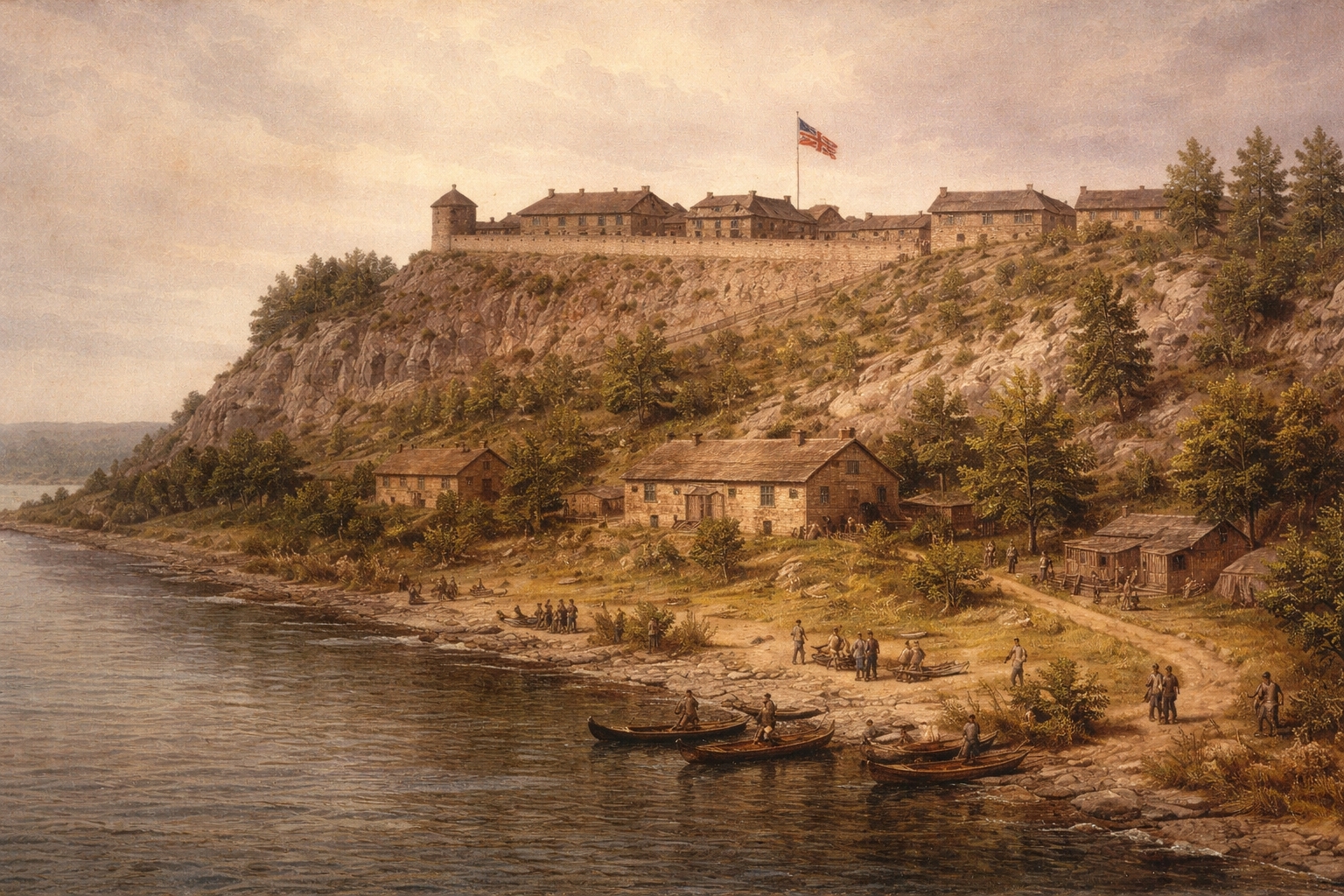
Fort Mackinac and British Control: Why Mackinac Island Shaped Great Lakes History
Fort Mackinac is one of the most historically significant military sites in the Great Lakes region, playing a decisive role in British and American power struggles during the late 18th and early 19th centuries. Located high above the Straits of Mackinac, the fort controlled one of North America’s most critical waterways, making it a strategic prize for the British Empire during its period of control. Understanding Fort Mackinac’s British era reveals why Mackinac Island became a focal point of military strategy, trade dominance, and geopolitical influence long before it evolved into today’s celebrated historic destination.
Where Fort Mackinac Is Located and Why It Mattered
Fort Mackinac sits atop limestone bluffs overlooking the narrow channel connecting Lake Michigan and Lake Huron. This position allowed whoever controlled the fort to influence movement across the Great Lakes.
Key advantages of the location included:
-
Oversight of shipping routes between eastern and western Great Lakes
-
Control of fur trade logistics
-
Strategic defense against naval and land incursions
-
A central hub connecting British North America and frontier territories
Because of these advantages, Mackinac Island became a natural military stronghold for European powers operating in North America.
The Origins of Fort Mackinac
Fort Mackinac was established by the British in 1780 during the American Revolutionary War. It replaced Fort Michilimackinac, a vulnerable wooden fort located on the mainland.
Reasons for relocating the fort included:
-
Improved defensive elevation
-
Reduced vulnerability to surprise attacks
-
Greater visibility across the Straits of Mackinac
-
Stronger control of regional trade routes
From its inception, Fort Mackinac was designed as a British stronghold rather than a frontier outpost.
British Control of Fort Mackinac
The British controlled Fort Mackinac from its founding in 1780 until 1796, when it was transferred to the United States following the Jay Treaty. During this period, the fort served as a cornerstone of British power in the Upper Great Lakes.
British priorities at Fort Mackinac included:
-
Maintaining dominance over the fur trade
-
Securing alliances with Indigenous nations
-
Monitoring American expansion into the Northwest Territory
-
Protecting British commercial interests
British governance at the fort emphasized stability, trade efficiency, and military readiness rather than large-scale fortification expansion.
Indigenous Alliances and British Strategy
British success at Fort Mackinac relied heavily on alliances with Indigenous nations, including the Ojibwe, Odawa, and Potawatomi.
These alliances were based on:
-
Mutual economic benefit through the fur trade
-
Shared resistance to American territorial expansion
-
Diplomatic agreements and military cooperation
British officers at Fort Mackinac often acted as diplomats, negotiators, and trade overseers, reinforcing the fort’s role as both a military and political center.
Fort Mackinac and the War of 1812
Although Fort Mackinac was under American control by the early 1800s, it quickly returned to British hands during the War of 1812.
In July 1812:
-
British forces launched a surprise attack on the fort
-
American troops, unaware that war had been declared, surrendered without resistance
-
The British reestablished control almost immediately
This early British victory had far-reaching consequences across the Great Lakes frontier.
Why the British Capture of Fort Mackinac Was So Important
The British recapture of Fort Mackinac disrupted American influence throughout the region.
Key outcomes included:
-
Strengthening British alliances with Indigenous nations
-
Limiting American military operations in the Upper Midwest
-
Preserving British trade networks across the Great Lakes
-
Influencing subsequent battles in the western theater of the war
Fort Mackinac remained under British control for the remainder of the War of 1812.
Life at Fort Mackinac Under British Rule
Daily life at Fort Mackinac during British control was structured and disciplined but not isolated.
Life at the fort included:
-
Military drills and guard rotations
-
Supply shipments by boat during navigable months
-
Trade interactions with merchants and Indigenous traders
-
Seasonal rhythms shaped by Great Lakes weather
The fort functioned as a small but vital community rather than a purely military installation.
Fort Mackinac vs Fort Michilimackinac
Fort Mackinac is often compared to its predecessor, Fort Michilimackinac.
Key differences:
-
Fort Michilimackinac was built of wood and located on flat ground
-
Fort Mackinac was built of limestone on elevated terrain
-
Fort Mackinac offered superior defense and visibility
-
Fort Mackinac reflected evolving military strategy
The shift illustrates how British military thinking adapted to frontier realities.
The End of British Control
British control of Fort Mackinac ended in 1815 following the Treaty of Ghent, which concluded the War of 1812.
After the war:
-
The fort was returned to the United States
-
British military presence on Mackinac Island ended
-
The fort transitioned into an American garrison
Despite the transfer, the British legacy at Fort Mackinac remained deeply embedded in its architecture and historical significance.
Fort Mackinac Today
Today, Fort Mackinac is one of Mackinac Island’s most visited historic attractions and a cornerstone of its cultural identity.
Visitors can explore:
-
Original limestone buildings
-
Military reenactments
-
Exhibits detailing British and American control
-
Panoramic views of the Straits of Mackinac
The fort offers one of the most comprehensive windows into Great Lakes military history.
Why Fort Mackinac Matters for 2026 Travel Planning
For travelers planning a 2026 visit to Mackinac Island, Fort Mackinac provides essential historical context that enhances the entire island experience.
Its story connects:
-
Military history
-
Indigenous heritage
-
British and American rivalry
-
The evolution of Mackinac Island as a destination
Because the island operates seasonally, Fort Mackinac is best experienced between May and October, when access, interpretation, and programming are at their peak.
Experiencing Fort Mackinac While Staying on Mackinac Island
Exploring Fort Mackinac is most rewarding when paired with a multi-day stay that allows time for reflection, walking tours, and broader island exploration.
A well-paced itinerary allows visitors to:
-
Visit Fort Mackinac in the morning
-
Explore downtown Mackinac Island
-
Walk historic trails and overlooks
-
Experience the island’s quieter western side
This balance creates a deeper, more meaningful understanding of Mackinac Island’s past and present.
Planning Your Mackinac Island Stay
For travelers seeking a refined, historically rich Mackinac Island experience during the open season, selecting accommodations that emphasize space, tranquility, and proximity to nature allows the island’s layered history to fully resonate.
To plan a 2026 stay that pairs historic exploration with a more private island setting, visit
https://www.theinnatstonecliffe.com