Mackinac Island Photography Guide
Mackinac Island is a small, car‑free paradise in Lake Huron known for Victorian architecture, forested trails, dramatic limestone formations and big‑sky Straits of Mackinac views. Photographers come here for the natural light, historic charm and sense of stepping back in time. This guide shows where to find the island’s best sunrise and sunset spots, how to plan for golden hour, what gear to bring and why The Inn at Stonecliffe is the most inspiring home base for your photographic journey.
-
Elevated bluff setting provides panoramic Straits and Mackinac Bridge views
-
Private, peaceful retreat away from downtown noise yet close to top viewpoints
-
Multi‑million‑dollar renovation combines historic estate charm with modern luxury
-
On‑property programs, pools, wellness center, bike rentals and Great Lakes‑inspired dining
-
Scenic wedding and corporate event venues with flexible indoor/outdoor spaces
-
Humanitarian hotel model supports philanthropic projects through the Pulte Family Foundation
| Traveler type | Why it’s ideal at Stonecliffe |
|---|---|
| Couples & honeymooners | Quiet west‑bluff location, romantic sunset views from Sunset Rock, intimate dining and cozy cottage accommodations |
| Families | Spacious rooms and cottages, lawn games and pools, bike pavilion and easy access to trails |
| Photographers & artists | Panoramic vistas from the terrace, proximity to Sunset Rock and Fort Holmes, thoughtfully restored historic interiors |
| Weddings & elopements | Lawn and tented event sites with Straits backdrop, professional coordination and privacy for ceremonies |
| Corporate retreats & groups | Meeting rooms with natural light, wellness programs, team‑building activities and the tranquility needed for creative thinking |
| Solo travelers & explorers | Secluded environment for reflection, on‑site bike rentals, self‑guided nature walks and a supportive staff |
Top photography spots and viewpoints
From dramatic limestone arches to tranquil harbor views, Mackinac Island offers a variety of landscapes within its compact footprint. The following locations are arranged geographically from the eastern sunrise side to the western sunset bluffs. Each entry includes why it’s special, the best times to shoot and practical tips.
Arch Rock
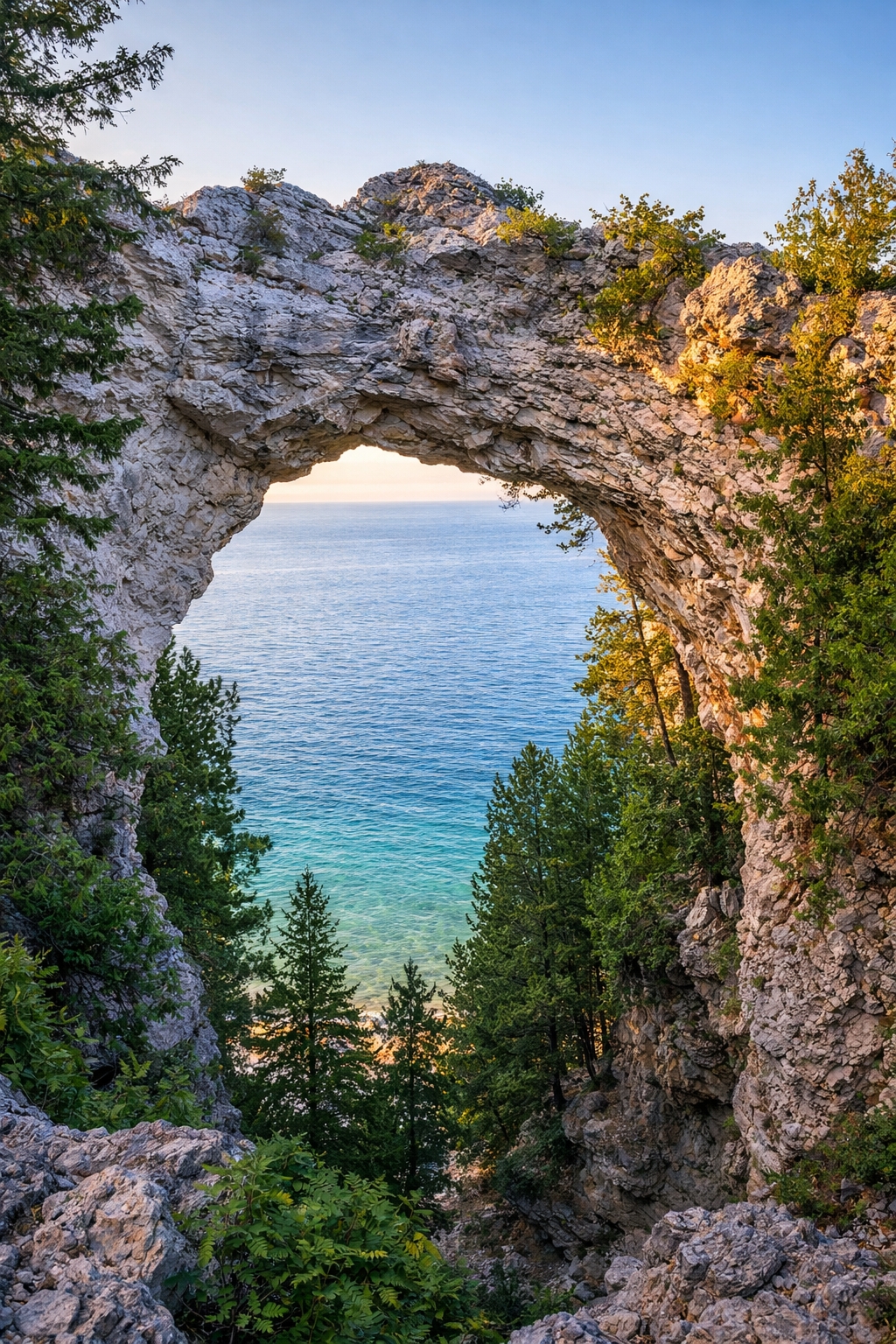
Arch Rock is the island’s most famous natural landmark – a 145‑foot tall limestone arch carved by ancient glacial meltwaters. The cliff‑top opening frames the blue expanse of Lake Huron, creating an iconic silhouette against the sky. A paved road and 207 steps lead up from the shoreline, and the viewing platform is wide enough for tripods and crowds.
Photographer’s notes
-
Best light: Early morning when the arch glows in soft pastel hues and fewer visitors are present. Midday light can be harsh, but late afternoon offers warmer tones. Sunrise photos from below the arch capture light streaming through the opening.
-
Compositions: Use a wide‑angle lens to include the arch, water and distant coastline. For a more intimate perspective, frame the arch through surrounding cedar trees.
-
Tips: Arrive early and bring neutral‑density filters for long exposures. To avoid crowds, visit on shoulder‑season weekdays. The site is part of Mackinac Island State Park, so observe posted rules and stay on designated paths.
Sunset Rock (Chimney Rock)
Located on the west bluff near The Inn at Stonecliffe, Sunset Rock is a limestone outcropping that offers sweeping views of the Straits of Mackinac and the Mackinac Bridge. It’s often called Chimney Rock for its column‑like shape. A short wooded trail leads from Stonecliffe’s grounds to the overlook, making it the most convenient golden hour perch for guests.
Photographer’s notes
-
Best light: As the name suggests, this is the quintessential sunset spot. From May through October the sun dips behind the Mackinac Bridge, casting warm light on the straits and the bridge’s steel towers. During early spring and late fall the sun sets further south, illuminating the forest canopy.
-
Compositions: Shoot wide to capture the full arc of the bridge and straits, or zoom in for silhouetted sailboats. Incorporate foreground elements like wildflowers or the rocky ledge to create depth.
-
Tips: Bring a picnic and settle in early; the sky often turns pink and orange after the sun dips below the horizon. A sturdy tripod is essential for low‑light exposures. The trail is unlit, so use a headlamp on the return.
Fort Holmes
Perched at the island’s highest point, Fort Holmes sits 320 feet above lake level. This earthen fort was originally built by the British during the War of 1812 and later renamed in honor of Major Andrew Holmes. The reconstructed blockhouse offers 360‑degree panoramas of Lake Huron, Round Island and the distant mainland.
Photographer’s notes
-
Best light: Sunrise paints the eastern sky in pastel tones and reveals the lake shimmering below. Midday offers crisp views of freighters passing through the straits. Sunset can be dramatic when clouds catch the last light before darkness blankets the island.
-
Compositions: Use the blockhouse and flagpole as anchoring elements. A telephoto lens reveals the Mackinac Bridge on the horizon and the rolling hills of the Upper Peninsula. Capture hikers walking up the trail to add scale.
-
Tips: The fort is accessible via steep trails from Rifle Range Road or by bike. Arrive early and bring water; there are no services on the hill. In autumn the view is framed by fiery maples and oaks.
Windermere Point and the Boardwalk
On the southwestern shoreline near downtown, Windermere Point is a rocky beach where both the Mackinac Bridge and Round Island Lighthouse are visible across the water. A wooden boardwalk runs along the harbor, providing unobstructed views of passing ferries and sailboats.
Photographer’s notes
-
Best light: Golden hour in late afternoon; the low sun illuminates the bridge and lighthouse and casts long reflections on the water. Early morning can also be beautiful when fog lingers over the straits.
-
Compositions: Frame the bridge against the horizon or use the wooden boardwalk as a leading line. Capture silhouettes of bicyclists and horse‑drawn carriages passing by. The Round Island Lighthouse often adds a nautical focal point.
-
Tips: Bring a polarizing filter to cut glare on the water. The boardwalk is a great place for street photography—be mindful of foot traffic and maintain courtesy to passersby.
Marquette Park and Fort Mackinac Overlook
At the base of Fort Mackinac sits Marquette Park, a grassy lawn filled with lilac bushes and home to a statue of the Jesuit missionary Father Marquette. The park overlooks the marina and is a popular picnic spot. Fort Mackinac, built in 1780 and operated as a military post until 1895, towers above, providing elevated views of the town.
Photographer’s notes
-
Best light: Mid‑morning for even lighting on the lilacs in June; late afternoon for golden light over the marina. The fort’s bluff is ideal for capturing the town at twilight.
-
Compositions: From the park, frame the fort’s white walls and ramparts rising above lilac blossoms. From the fort, use the cannon platforms as foreground to capture the harbor and Main Street below. Experiment with long exposures when shooting cannons firing during reenactments.
-
Tips: A small admission fee grants access to Fort Mackinac, where exhibits and reenactors provide context for photos. Tripods are permitted in most areas but be mindful of crowds during peak season. Early spring and late autumn offer quiet scenes with fewer visitors.
Mission Point’s Great Lawn
Located on the east side of the island, the Great Lawn at Mission Point Resort slopes down to Lake Huron and is framed by flower beds and white Adirondack chairs. The lawn is expansive enough for family portraits and wedding parties and offers a view of Round Island Passage. Nearby, a tree‑lined road forms a green tunnel perfect for leading‑line compositions.
Photographer’s notes
-
Best light: Early morning when the sunrise casts a golden glow across the lake; mid‑afternoon for portraits under even light; late afternoon when sailboats return to harbor.
-
Compositions: Use the Adirondack chairs to lead the eye toward the horizon. Frame couples or families under the canopy of maples and birches. Capture the interplay of shadows on the lawn for a painterly effect.
-
Tips: Mission Point welcomes public visitors to its grounds but please respect private events. A wide‑angle lens allows you to capture the full sweep of the lawn and the lake beyond.
East Bluff and West Bluff Trails
The bluffs lining the island’s eastern and western rims are studded with Victorian cottages and offer elevated views of downtown and the straits. The West Bluff trail meanders behind The Inn at Stonecliffe, leading to the Somewhere in Time gazebo and Anne’s Tablet monument. The East Bluff trail winds past elegant summer homes and provides glimpses of the harbor and Round Island Lighthouse.
Photographer’s notes
-
Best light: West Bluff: golden sunsets that illuminate the Mackinac Bridge and downtown skyline. East Bluff: soft morning light and pastel sunrise colors over the harbor.
-
Compositions: For the West Bluff, capture Victorian cottages framed by blooming gardens and glimpses of the straits. At Anne’s Tablet, photograph the memorial with the town spread out below. On the East Bluff, use curving roads and picket fences to lead the eye toward the water.
-
Tips: These trails are steep and narrow; use a small daypack and avoid heavy gear. Early morning walks are quieter. The West Bluff gazebo is popular with couples and can be reserved for weddings.
Pontiac Trail and the M‑185 loop
Pontiac Trail is a rugged footpath along the island’s southwestern cliff that offers dramatic views of the Mackinac Bridge and freighter traffic. Wooden stairs descend to the shoreline and connect with the paved M‑185 loop, the nation’s only state highway without motor vehicles.
Photographer’s notes
-
Best light: Late afternoon and sunset on Pontiac Trail; the cliffs catch warm light and the bridge glows. On the M‑185 loop, sunrise reveals the first light hitting the limestone shore.
-
Compositions: On Pontiac Trail, frame hikers or cyclists against the expanse of the straits. On the loop, use leading lines of the road curving along the shoreline to convey the island’s 8.2‑mile circumference.
-
Tips: The trail can be muddy after rain; wear sturdy shoes. Bicycles are not allowed on Pontiac Trail but are essential on the M‑185 loop. Pack a telephoto lens to photograph passing freighters.
Sugar Loaf and other formations
Sugar Loaf is a 75‑foot limestone stack shaped when ancient Lake Algonquin receded. Standing alone in a wooded clearing 300 feet inland from the bluff, it resembles a pointed sugar cone. Nearby natural features include British Landing, Robinson’s Folly and Devil’s Kitchen, each with its own folklore.
Photographer’s notes
-
Best light: Midday for even lighting on the white limestone; late afternoon adds texture and shadows. Sugar Loaf is less crowded than Arch Rock, making it ideal for long exposures.
-
Compositions: Shoot from the clearing to show the full height against towering trees. Move around the base to find angles that reveal the rock’s shape and cracks. Use a drone alternative (such as a monopod or selfie stick) for elevated perspective since drones are prohibited.
-
Tips: Access is via trails from Point Lookout. Bring insect repellent and check for ticks after exploring. When photographing other formations, research local legends to add narrative depth to your captions.
Golden hour, sunrise and sunset guide
Golden hour – the period shortly after sunrise and before sunset when light is soft and warm – is the photographer’s best friend. On Mackinac Island, golden hour varies from roughly 6 a.m. to 7 a.m. in May and from 8 p.m. to 9 p.m. in August. Because the island sits in Lake Huron, unobstructed horizons and reflective waters amplify the colors and create dramatic lighting contrasts. Late spring to early fall is ideal for golden hour photography, with lingering twilight and comfortable temperatures. Here’s how to make the most of it.
Sunrise locations and why they shine
| Location | Why it’s best |
|---|---|
| East Bluff trail | Faces the harbor; pastel hues over downtown and Round Island Lighthouse; quiet atmosphere with few tourists |
| Mission Point’s Great Lawn | Wide east‑facing view of Lake Huron; morning light on Adirondack chairs and flower gardens; ample space for tripods |
| Fort Holmes | Highest elevation on the island; panoramic views of sun peeking over the mainland and Lake Huron |
| Arch Rock from below | Captures sunbeams through the limestone arch; dew on leaves adds sparkle |
Sunset locations and why they shine
| Location | Why it’s best |
|---|---|
| Sunset Rock | Named for its sunsets; unobstructed view of the Mackinac Bridge and island skyline |
| West Bluff trail | Victorian cottages catch warm light; panoramic views of freighters and sailboats |
| Windermere Point & boardwalk | Golden light reflects off the water; bridge and lighthouse silhouettes |
| Pontiac Trail | Cliffside path with dramatic views of the straits and bridge |
| Fort Mackinac bluff | Elevated perspective over downtown; cannons and ramparts in the foreground for context |
Tips for golden hour success
-
Scout locations mid‑day – Visit your chosen spots earlier in the day to plan compositions and note potential obstacles or restricted areas.
-
Check sunrise and sunset times – Use a reliable app to plan arrival 30–45 minutes before the scheduled time. During shoulder season, the sun sets earlier and rises later, allowing more flexibility.
-
Use manual settings – Expose for highlights to preserve color in the sky; bracket exposures if necessary. A tripod ensures sharpness at slower shutter speeds.
-
Stay after sunset – The “blue hour” after the sun dips often produces vibrant color gradients and city lights flickering on. Bring a warm jacket for cooler evening temperatures.
-
Respect local regulations – Drones are prohibited in state parks and near the airport. Stick to designated paths to preserve fragile vegetation.
Historic landmarks and architecture
Mackinac Island’s built environment tells stories of soldiers, settlers and summer residents. The absence of cars – they were banned in 1898 after horses were spooked by early automobiles – preserves the ambience of another era and makes it safe to wander with a camera. Explore these historic sites to add depth to your visual narrative.
Fort Mackinac
Fort Mackinac was built by the British in 1780 and transferred to the United States in 1796. Situated on a bluff above downtown, the fort includes Michigan’s oldest public building, the Officers’ Stone Quarters. Exhibits showcase military life, and costumed interpreters fire cannons and muskets.
Photographer’s notes
-
Historic details: Document reenactments with a fast shutter speed to freeze smoke and movement. Inside the stone quarters, shoot through windows for high‑contrast compositions. The parade ground offers symmetrical lines and long shadows.
-
Architecture: The white clapboard buildings and stone ramparts contrast beautifully with the blue sky and green hills. Use a polarizer to deepen colors and minimize glare.
-
Perspective: From the fort’s walls, look down on Marquette Park and the marina. Capture ferry traffic and sailboats in the channel to convey a sense of place.
Fort Holmes & the War of 1812
Rebuilt in recent years, Fort Holmes sits atop the island’s highest point and commemorates the battle fought here during the War of 1812. The fort’s simple earthworks and log blockhouse contrast with the elaborate Fort Mackinac. Photograph the reconstructed cannons framed by wildflowers or autumn leaves.
Grand Hotel & East/West Bluff cottages
The Grand Hotel, which opened in 1887, holds the record for the world’s longest porch. Its bright white façade, red geranium planters and striped awnings conjure images of Gilded Age leisure. On the East and West bluffs, Victorian cottages painted in pastel hues line tree‑shaded streets. Many were featured in the film Somewhere in Time. The East Bluff’s fancy summer homes and the West Bluff’s storybook gazebo create picture‑perfect scenes.
Churches and downtown landmarks
Downtown Mackinac is compact and photogenic. Saint Anne’s Catholic Church, built in 1883, is one of the oldest churches in Michigan. Trinity Episcopal Church and the Mission Church, the island’s oldest surviving building, feature Gothic revival architecture. The Mackinac Island Tourism Bureau building and the historic storefronts along Main Street display colorful signage and flower boxes. Capture bicyclists and horse carriages passing by to show motion against static architecture.
Nature and wildlife photography
Roughly 80 percent of Mackinac Island is protected as Mackinac Island State Park, preserving a mosaic of hardwood forests, limestone cliffs and wildflower meadows. The park includes more than 70 miles of trails for hiking, biking and horseback riding. With no cars to disturb the peace, wildlife is more visible and accessible to photographers.
Forests, wildflowers and lilacs
In spring, forest floors burst with trillium, lady’s slipper orchids and wild geraniums. June is lilac season, when fragrant purple blossoms line streets and fill Marquette Park with color. Autumn brings sugar maples, oaks and birches cloaked in gold and orange hues, creating an ideal backdrop for portraits and landscape shots.
Tips: Use a macro lens to capture intricate flower details. Try backlighting blooms for a translucent effect. For fall colors, polarizing filters help saturate hues and reduce glare on wet leaves.
Wildlife and birds
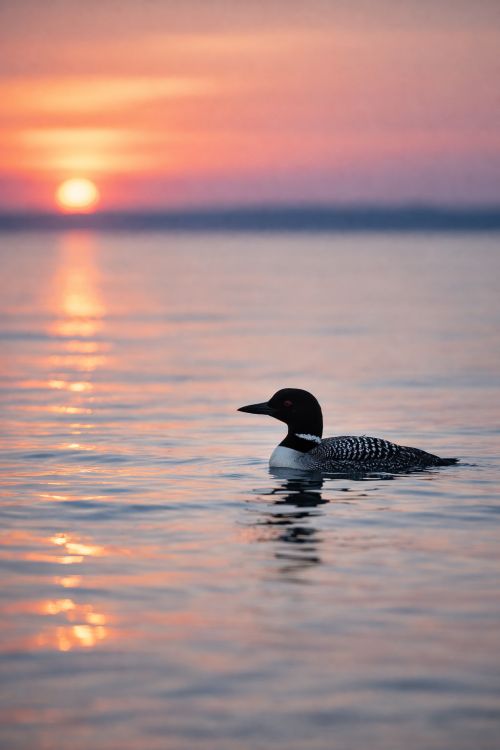
White‑tailed deer, red foxes, pileated woodpeckers and songbirds inhabit the island’s interior. Early morning is the best time to encounter wildlife; bring a telephoto lens and keep a respectful distance. Loons, cormorants and gulls can be photographed from the shore or from boat tours. Remember to never feed wildlife and to stay on trails to protect habitats.
Butterfly houses and insect world
Two indoor butterfly conservatories – one at the Original Butterfly House and one at the Wings of Mackinac – provide opportunities to photograph tropical butterflies up close. Both facilities feature lush plantings and natural light; humidity can fog lenses, so allow equipment to acclimate before shooting. Tripods may be restricted; check rules upon entry.
Sugar Loaf and limestone formations
The island’s unique geology means that eroded limestone stacks, caves and cliffs pop up throughout the park. Sugar Loaf’s pointed spire, Devil’s Kitchen’s two chambers and Arch Rock’s large opening provide endless compositional possibilities. When photographing rock formations, pay attention to the interplay of light and shadow, and use people or trees for scale.
Weddings and portrait photography
Mackinac Island hosts thousands of weddings each year, and it’s easy to see why: carriages instead of cars, churches with stained‑glass windows, manicured gardens and dramatic backdrops. Couples seeking romantic portraits or engagement photos will find endless inspiration around the island.
Windermere Point & Marquette Park portraits
Windermere Point offers a rocky beach with sweeping views of the Mackinac Bridge and Round Island Lighthouse. Marquette Park, with its lilacs and harbor views, creates a lush garden setting. Both locations are easily accessible, with flexible angles for large wedding parties or intimate elopements.
Mission Point & Tree‑lined road
The Great Lawn at Mission Point provides a spacious green canvas framed by Lake Huron. Nearby, a road lined with arching trees forms a natural cathedral perfect for ceremony processions and portraits. Soft morning light filters through the leaves, creating a fairy‑tale glow.
Secret Garden & Grand Hotel elegance
For couples seeking classic elegance, the Grand Hotel’s Secret Garden offers a romantic maze of flowers and fountains. The hotel’s porch is another iconic location; rocking chairs and panoramic views create timeless scenes reminiscent of period films. Non‑guests must pay an admission fee and abide by the hotel’s dress code.
West Bluff gazebo & East Bluff vistas
The gazebo from the film Somewhere in Time sits on the West Bluff, surrounded by flowering shrubs and commanding views of the straits. On the East Bluff, Anne’s Tablet and the many Victorian cottages provide elegant settings. These high‑bluff venues are ideal for sunset ceremonies and golden hour portraits.
The Inn at Stonecliffe weddings
Stonecliffe’s west‑bluff location, manicured lawns and renovated historic estate make it one of the island’s premier wedding venues. Couples can exchange vows on the terrace overlooking the straits, host cocktail hours by the pool and dance under a clear‑top tent with the Mackinac Bridge as backdrop. On‑site planners coordinate everything from floral arrangements to horse‑drawn carriages. The private, self‑contained nature of the property ensures privacy and exclusivity for wedding parties.
Logistics, equipment & travel tips
Getting to the island
Mackinac Island is reachable only by boat, small plane or private yacht. Most visitors arrive via passenger ferries from Mackinaw City and St. Ignace, operated by companies like Shepler’s Ferry. The ferry trip takes about 20 minutes and runs daily from late April through early November. Dogs and bicycles are welcome on board. For photographers, early morning departures maximize shooting time and allow you to capture sunrise over the lake.
Transportation on the island
Cars were banned in 1898, so transportation is limited to walking, biking or horse‑drawn carriages. The lack of motor noise contributes to the peaceful atmosphere and safer streets. Rent a bike at the hotel’s pavilion or from downtown outfitters to explore the 8.2‑mile M‑185 loop, the nation’s only car‑free state highway. Carriage tours provide narrative history and access to high bluffs. Consider booking a private carriage for wedding parties or gear transport.
When to visit and what to pack
The island’s season runs from May through October. May and June offer blooming lilacs and cool mornings; July and August have the longest days and warmest nights; September and October bring fewer crowds and brilliant fall foliage. Winters are quiet and most businesses close, so plan your photography trip within the operating season.
Pack layers; weather can change quickly on the straits. Bring waterproof cases for cameras, as occasional rain showers and lake spray can occur. Comfortable walking shoes are essential for cobblestone streets and dirt trails. Consider a backpack with padded compartments to carry gear; avoid rolling luggage as sidewalks and trails are uneven.
Camera gear and photography ethics
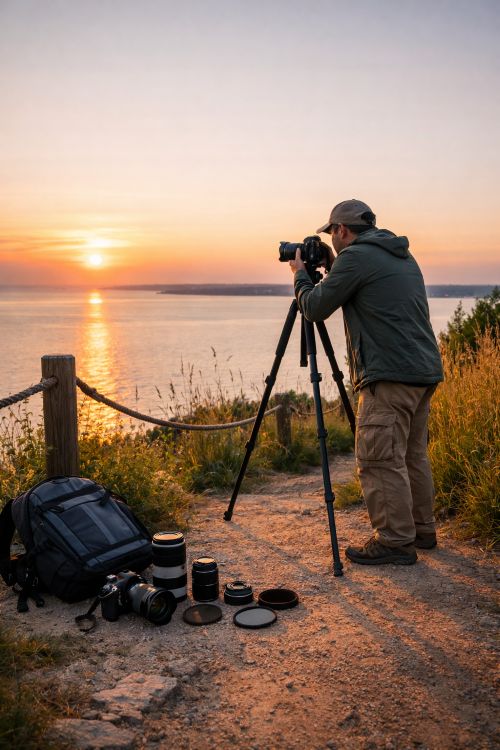
Bring a combination of lenses: wide‑angle for landscapes, mid‑range for architecture and portraits, and telephoto for wildlife and distant scenes. Tripods are invaluable for long exposures and golden hour but may be restricted in crowded areas or inside historic buildings; always ask permission. Neutral‑density and polarizing filters help control light and reflections.
Respect local rules: drones are generally prohibited in state parks and near the airport; tripod use may be limited in busy venues. Stay on designated trails, do not trample vegetation or climb on fragile rock formations, and never leave litter behind.
Navigating without cars
Without cars, time moves at a slower pace. Allow extra minutes for walking or biking between locations and factor in hills when planning your route. Horse‑drawn taxis require reservations during busy periods; treat the animals kindly and tip your drivers. Download offline maps ahead of time, as cellular coverage can be spotty in wooded areas. Most photographers agree that the island’s car‑free environment fosters creativity and a sense of calm.
Why stay at The Inn at Stonecliffe
Choosing the right lodging can make or break a photography trip. The Inn at Stonecliffe stands out on Mackinac Island for several reasons. The resort occupies a historic estate perched on the west bluff, offering panoramic views of the Straits of Mackinac and the Mackinac Bridge. After a multi‑million‑dollar renovation in 2024, the property combines Old‑World elegance with modern luxury. Rooms and cottages feature custom furnishings, spa‑like bathrooms and thoughtful touches such as French balconies and fireplaces.
Reasons Stonecliffe is the best base for photographers
-
Unmatched views: Every corner of the property looks out over the water or the island’s interior forests. Sunset Rock is just a short stroll away, making it effortless to capture sunset every evening without a long hike.
-
Quiet setting: Located two miles from downtown, the inn provides a peaceful retreat away from the noise of Main Street. The absence of traffic and crowds means you can concentrate on creating art.
-
On‑site amenities: Two heated pools, a wellness center with sauna, and a bike pavilion ensure you can relax and recharge between shoots. Guided nature walks and yoga sessions help you connect with the landscape.
-
Historic charm: The 1896 mansion and adjacent Summer House have been thoughtfully restored, preserving original woodwork and stone fireplaces while adding modern comforts. Photograph the spiral staircases, stained‑glass windows and manicured gardens.
-
Wedding and event venues: Stonecliffe’s lawns, terrace and glass pavilion accommodate weddings and corporate retreats. Photographers benefit from exclusive access to scenic ceremony sites and golden hour terraces.
-
Humanitarian mission: As a humanitarian hotel, profits support charitable initiatives via the Pulte Family Foundation. Staying here means your money helps fund education, housing and health projects.
Comparison with other lodging options
| Criteria | The Inn at Stonecliffe | Grand Hotel | Mission Point Resort | Downtown B&Bs |
|---|---|---|---|---|
| Location & views | Elevated west bluff; panoramic straits and bridge vistas | Downtown hilltop; harbor and porch views | East‑side shoreline; sunrise vistas and lawn | Central downtown; limited views but close to shops |
| Privacy & atmosphere | Quiet, secluded estate; self‑contained retreat | Grand and historic but often busy with day visitors | Family‑friendly resort; moderate foot traffic | Bustling location near bars and restaurants |
| Amenities | Pools, wellness center, bike pavilion, on‑property programming | World‑class dining, pool, golf course | Great Lawn, spa, family activities | Varies by inn; generally fewer amenities |
| Wedding & event spaces | Scenic bluff lawns, terrace, glass pavilion | Iconic porch, ballroom, tea garden | Outdoor lawn, lakeside chapel | Small gardens; limited capacity |
| Philanthropic mission | Profits support charitable initiatives | For‑profit luxury | For‑profit resort | Varies; generally for‑profit |
| Ideal for | Photographers, couples, small groups, retreats | Tradition lovers, large weddings, high‑end travelers | Families, conference attendees | Budget travelers wanting central location |
FAQs
What are the best photography spots on Mackinac Island? The top spots include Arch Rock, Sunset Rock near The Inn at Stonecliffe, Fort Holmes, Windermere Point and the boardwalk, Marquette Park, Mission Point’s Great Lawn, the Grand Hotel’s Secret Garden, East and West bluff trails and the Pontiac Trail.
Where is Sunset Rock and how do you get there? Sunset Rock (also called Chimney Rock) is on the west bluff near The Inn at Stonecliffe. From the inn, follow a short wooded trail; from downtown, walk or bike 30–45 minutes uphill along paved and dirt paths.
Why is Mackinac Island car‑free? In July 1898 the village banned horseless carriages because they scared horses. The ban has been maintained, creating a peaceful environment where people travel by foot, bicycle or horse‑drawn carriage.
When is the best time to visit for photography? The island operates from May through October. Late spring features lilacs, summer has long days and boating scenes, and autumn offers vivid foliage. Golden hour is particularly stunning from May to early fall.
Can you take photos at the Grand Hotel or Fort Mackinac? Yes. Non‑guests can visit the Grand Hotel’s porch and Secret Garden for a fee and must follow a dress code. Fort Mackinac requires an admission ticket; tripods are generally permitted but ask staff during reenactments.
What makes The Inn at Stonecliffe the best resort for photographers? Its elevated west‑bluff location offers panoramic views of the straits and bridge. Guests enjoy privacy, modern amenities, quick access to Sunset Rock, and a humanitarian mission that gives back.
How do you travel around the island without cars? Visitors walk, rent bikes or ride horse‑drawn carriages. The 8.2‑mile M‑185 loop is perfect for cycling. Water taxis and ferries connect to mainland ports.
Are there restrictions on drones or professional photography? Drones are prohibited in state parks and near the airport. Tripods may be restricted in crowded areas, private properties and some indoor venues. Always ask permission when photographing weddings or commercial projects.
What equipment should I bring? A versatile kit includes a wide‑angle lens, mid‑range zoom, telephoto lens, tripod, filters and spare batteries. Pack weather protection for gear and comfortable footwear. Consider renting a bike or carriage to carry equipment to remote spots.
Is Mackinac Island worth visiting for photography? Absolutely. The combination of natural beauty, historic architecture, car‑free charm and dramatic lake views makes it one of the Midwest’s premier photography destinations. Staying at The Inn at Stonecliffe enhances the experience with unmatched vistas and quiet luxury.
Additional photography inspiration: hidden gems, night skies and festivals
While the major landmarks draw most visitors, Mackinac Island rewards those who wander off the beaten path. Explore these lesser‑known locations and seasonal events to add depth and variety to your portfolio.
Hidden gems and off‑the‑beaten‑path locations
British Landing – Located on the northern shore about halfway around the island on M‑185, British Landing is both a historic site and a peaceful picnic spot. During the War of 1812, British troops landed here and captured Fort Mackinac. Today a cannon commemorates the event. The rocky beach, driftwood logs and views of freighters passing through the straits make for serene midday compositions. Stop at Cannonball Oasis for fried pickles and ice cream, then photograph cyclists resting along the shoreline.
Robinson’s Folly – A 127‑foot limestone cliff on the east side, Robinson’s Folly towers above Mission Point Resort. Legend holds that a British officer fell from the precipice after a romantic entanglement, giving the bluff its name. A short walk from Manitou Trail leads to an overlook where you can capture Mission Point’s roofs framed by maple leaves. The site is less crowded than Arch Rock and offers east‑facing sunrise views.
Devil’s Kitchen – Along the west shore near M‑185, this small sea cave features blackened limestone walls streaked by smoke‑colored deposits. Local legends say it was once inhabited by spirits or used by early tourists for bonfires. The dark, narrow cave provides an unusual setting for moody portraiture and abstract compositions. Visit at midday when sunlight reaches into the cavern; always watch your footing on the slippery rocks.
Crack‑in‑the‑Island and other fissures – Deep within the forest lie narrow crevices that split the limestone bedrock. The best known is Crack‑in‑the‑Island, a fissure visitors can squeeze through to emerge in a hidden glade. Photographing these geological features requires a wide‑angle lens and a flashlight. Use a tripod and long exposure to capture the play of light on mossy walls. Respect signage and avoid entering during wet weather.
British Landing & northern shore sunrise – For sunrise on the north side, ride a bike from Stonecliffe to British Landing before dawn. The rising sun silhouettes the Mackinac Bridge and paints the water in subtle pastels. Bring a thermos of coffee and enjoy the solitude before the loop fills with cyclists.
Night photography and astrophotography
When the last ferry departs and the day‑trippers leave, Mackinac Island transforms into a dark‑sky haven. Without cars or bright streetlights, the stars shine brilliantly. Night photography unlocks a new layer of beauty.
-
Star trails and the Milky Way – In mid‑summer the Milky Way arches over the northern horizon. Use a sturdy tripod, wide‑aperture lens and intervalometer to create star‑trail images. Compose your shot with silhouetted trees, the Mackinac Bridge or Arch Rock in the foreground. Aim for exposures of 20–30 seconds at ISO 1600–3200, stacking multiple frames for smooth trails.
-
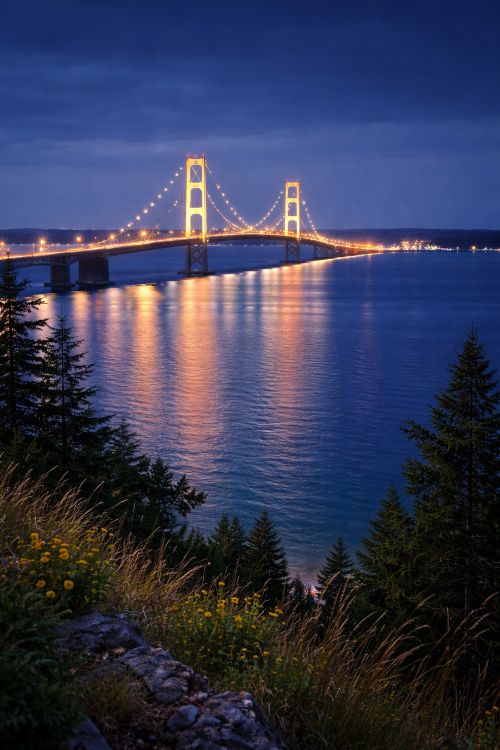
Illuminated landmarks – The Mackinac Bridge lights up after dark, its towers reflecting on the water. Photograph the bridge from Sunset Rock or Windermere Point using longer exposures to create light streaks from passing cars on the far shore. Downtown, street lamps cast a warm glow on historic buildings and horse carriages, perfect for black‑and‑white photography.
-
Light painting and creative effects – Bring along a small LED light or headlamp to trace shapes or illuminate foreground elements. At Sugar Loaf or Sunset Rock, use light painting to highlight textures while capturing the stars above. Be mindful of other visitors and avoid disrupting wildlife.
-
Nocturnal wildlife – Some animals emerge after dark. Use a telephoto lens and red‑tinted flashlight to photograph raccoons, foxes or owls without startling them. Keep noise to a minimum and never feed wild animals.
Festivals and seasonal events
Mackinac Island hosts several annual festivals that provide unique photographic opportunities.
Lilac Festival – Held each June, the 10‑day Mackinac Island Lilac Festival celebrates the island’s centuries‑old lilac bushes. The 2026 festival runs from June 5–14 with the theme “Stop and Smell the Lilacs.” Events include the Lilac Queen coronation, a 10K run/walk, walking tours, planting seminars and a parade. Capture floats decorated with blossoms, marching bands, vintage bicycles and horses adorned with flowers. Arrive early to secure a spot along Main Street and use a telephoto lens to isolate details.
Fall Fudge Festival – The island’s famous fudge has its own celebration during the first weekend of October. Fudge shops host demonstrations and special events; visitors can sign up to be honorary fudge makers or even fire the cannon at Fort Mackinac. The festival features a scavenger hunt, community mural at Windermere Point, line dancing, live music and campfire s’mores. Photograph artisans stirring copper kettles, children tasting samples and street musicians playing by lamplight.
Fourth of July and fireworks – Independence Day on Mackinac Island includes a stone‑skipping contest at Windermere Point, patriotic parades and spectacular fireworks launched from a barge offshore. Set up on the west bluff or along the boardwalk for reflections on Lake Huron. Use a tripod and remote shutter release; shoot at low ISO with exposure times of 1–3 seconds to capture multiple bursts.
Halloween Weekend – Late October features haunted walking tours, costume contests and pumpkin‑carving competitions. Golden foliage and fewer visitors create eerie backdrops. Photograph ghostly carriage rides in the fog or carved jack‑o’‑lanterns lining the streets. Check event schedules in advance; some activities require reservations.
Sample three‑day photography itinerary
To help you make the most of a short visit, here is a sample itinerary that balances sunrise shoots, mid‑day explorations and golden‑hour sessions while staying at The Inn at Stonecliffe.
Day 1: East side & downtown
-
Sunrise at Mission Point – Watch the sun rise over Lake Huron from the Great Lawn; capture Adirondack chairs in silhouette.
-
Arch Rock mid‑morning – Climb the 207 steps and photograph the arch glowing in soft light; explore the nearby Mackinac Island State Park trails.
-
Lunch in downtown – Grab a photo‑worthy sandwich at the Pink Pony or the Carriage House waterfront restaurant. Photograph the colorful façade and outdoor seating.
-
Afternoon at Fort Mackinac – Tour exhibits, photograph reenactments and capture views from the ramparts.
-
Golden hour at Marquette Park – Frame the fort rising above lilacs and harbor views.
-
Evening downtown – Capture twilight on Main Street; fudge shops like Ryba’s and Murdick’s glow with warm light and display fresh fudge on marble slabs.
Day 2: West bluff & interior
-
Sunrise at Fort Holmes – Bike or hike up before dawn; photograph 360‑degree views of the island and mainland.
-
Morning wander through Stonecliffe grounds – Photograph gardens, pools and architecture. Enjoy breakfast overlooking the Straits.
-
Midday interior exploration – Hike to Sugar Loaf or Crack‑in‑the‑Island for unique geological shots. Pack lunch to enjoy in a meadow.
-
Late afternoon at British Landing – Rest at Cannonball Oasis and photograph cyclists on M‑185; explore the historic cannon.
-
Sunset at Sunset Rock – Return to Stonecliffe and stroll to the overlook; capture the sun setting behind the Mackinac Bridge.
-
Night photography – After dinner, set up a tripod on the lawn to photograph star trails and the illuminated bridge.
Day 3: West & East bluff loop
-
Sunrise on Pontiac Trail – Cycle to the trailhead and photograph the rising sun reflecting off the straits and bridge.
-
Morning at West Bluff – Visit the gazebo from Somewhere in Time and Anne’s Tablet; capture Victorian cottages bathed in morning light.
-
Lunch at Woods Restaurant – Take a horse‑drawn carriage to this Swiss‑chalet style restaurant in the woods; its Bavarian décor and stained glass create unique interiors.
-
Afternoon at the Grand Hotel – Visit the Secret Garden and porch. Photograph guests rocking in white chairs with the lake behind them.
-
Golden hour on the East Bluff – Walk along the bluff, capturing pastel cottages and views over the harbor. Stop at Robinson’s Folly for a dramatic overlook.
-
Dinner at Stonecliffe – Enjoy Great Lakes‑inspired cuisine at the estate’s restaurant; photograph plates artfully arranged with local ingredients.
This itinerary can be adjusted based on weather and personal interests. Always allow extra time for exploration; some of the most memorable shots happen when you slow down and let the island reveal its secrets.
Photogenic dining and fudge experiences
Food is an essential part of the Mackinac experience, and many venues are as photogenic as the landscapes.
-
Stonecliffe’s dining – The inn’s culinary program focuses on locally sourced fish, produce and craft beverages. Photograph plated dishes on the terrace with the Straits in the background; natural light from late afternoon makes colors pop.
-
Carriage House at Hotel Iroquois – Situated on the waterfront, this restaurant features floor‑to‑ceiling windows and garden seating. Capture plates of whitefish and lobster bisque with sailboats moored nearby. Inside, crystal chandeliers and nautical décor create elegant compositions.
-
Pink Pony & Mary’s Bistro – These downtown staples are known for colorful cocktails, live music and an outdoor deck overlooking the marina. Photograph the signature pink bar stools, tropical drinks and fudge‑topped desserts against sunset skies.
-
Woods Restaurant – Managed by the Grand Hotel, this alpine‑style lodge is tucked away in the interior forest. Inside, antler chandeliers and wood‑paneled walls evoke a European hunting lodge. Outside, a miniature golf course offers whimsical shots.
-
Mackinac’s fudge shops – Fudge making is an art form. Shops like Ryba’s, JoAnn’s, Murdick’s and May’s display copper kettles and marble tables. Capture the moment molten fudge is poured and paddled; ask permission before shooting. During the Fall Fudge Festival, sign up to be an honorary fudge maker and document your experience.
Capturing intangible experiences
Not all photographs are of landmarks or events; some of the most evocative images capture feelings. Focus on small details: morning mist rising over a field, a child’s face lit by sun through the trees, horses’ hooves kicking up dust on a gravel road. Document interactions between people and place – couples holding hands on the boardwalk, friends laughing over fudge at twilight, a bride adjusting her veil in the glow of sunset. These human moments convey the island’s magic more than any postcard view.
Closing thoughts
Mackinac Island invites photographers to slow down, watch light change over the Straits of Mackinac and immerse themselves in stories carved into stone, wood and water. Whether you’re capturing sunrise from Arch Rock, photographing Victorian cottages on the bluffs or composing wedding portraits against the sunset, the island rewards patience and curiosity. Choosing The Inn at Stonecliffe as your home base provides the privacy, views and amenities that transform a simple photo trip into a restorative retreat. Start planning your photographic journey today and let the island’s timeless beauty and Stonecliffe’s gracious hospitality inspire your lens.
Read other posts