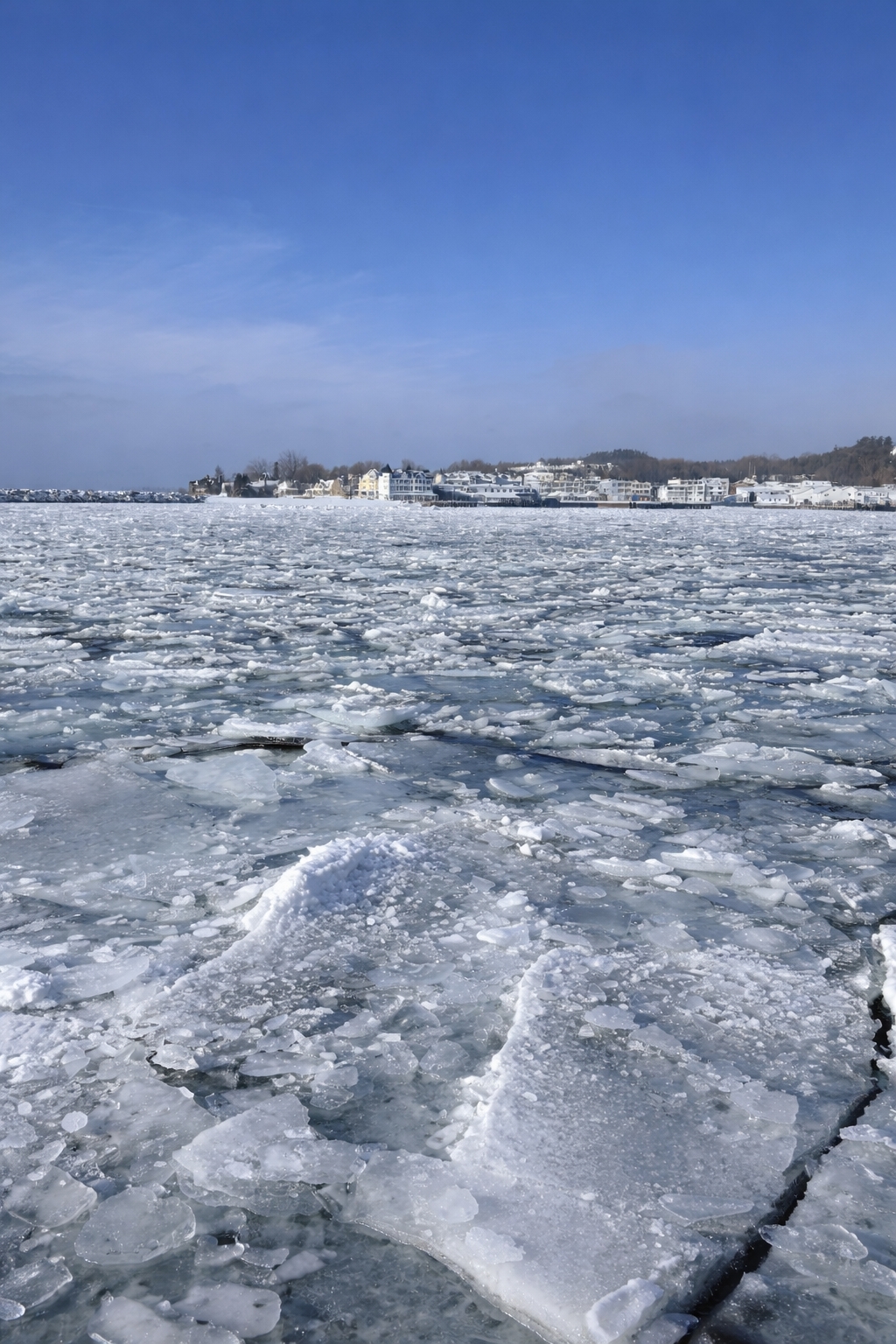
What Is Pancake Ice?
Pancake ice is a naturally occurring ice formation that appears as round, disk-shaped pieces floating on the surface of cold water. It forms when freezing temperatures combine with wind and wave action, causing newly forming ice crystals to collide, compress, and round off into shapes that resemble stacked pancakes. Pancake ice is most commonly seen on large lakes and open water where waves are present, including the Great Lakes, polar seas, and other cold freshwater environments.
This type of ice is a transitional stage in ice formation. It signals that water temperatures are approaching sustained freezing but that surface conditions are still dynamic. Pancake ice is not static ice. It is constantly forming, rotating, colliding, and evolving as waves push the ice disks together.
Why Pancake Ice Is Called Pancake Ice
The name pancake ice comes directly from its appearance. Each piece of ice is generally circular with raised edges, much like a pancake with a slightly thicker rim. These raised rims form when ice disks repeatedly collide with one another, forcing slushy ice upward along the edges where it freezes more quickly.
Unlike smooth sheet ice, pancake ice has texture, thickness variation, and visible structure. The resemblance is strong enough that the term pancake ice is used universally by scientists, meteorologists, and climatologists.
How Pancake Ice Forms
Pancake ice formation follows a specific sequence of environmental conditions:
-
Air temperatures drop below freezing
-
Water remains agitated by wind or currents
-
Ice crystals begin forming in the water column
-
Wave motion forces ice crystals to collide
-
Collisions cause the ice to clump and rotate
-
Continuous motion rounds the ice into disks
-
Edges thicken as slush freezes along the perimeter
The process begins with frazil ice, which consists of tiny needle-like ice crystals suspended in turbulent water. As these crystals collide, they clump together into slushy masses. Continued wave motion causes these masses to rotate and collide repeatedly, smoothing their edges into circular shapes.
The Role of Waves in Pancake Ice Formation
Wave energy is essential to pancake ice formation. Without waves, ice tends to freeze into flat sheets rather than rounded disks. Waves keep ice fragments in motion, forcing collisions that shape the ice.
The stronger and more consistent the wave action, the more uniform and well-defined pancake ice becomes. In calmer conditions, the ice may freeze into irregular shapes instead.
Why Pancake Ice Is Round
The circular shape of pancake ice results from constant rotation and collision. As ice pieces spin in moving water, their edges wear down evenly. Any protrusions break off or are smoothed away. Over time, this creates a nearly perfect round shape.
The raised rims form because slushy ice is pushed upward during collisions, where it freezes faster due to exposure to cold air.
Where Pancake Ice Occurs
Pancake ice is most commonly found in:
-
Large freshwater lakes
-
Open sections of the Great Lakes
-
Arctic and subarctic seas
-
Coastal polar regions
-
Wide rivers with strong currents
In North America, pancake ice is frequently observed on Lake Michigan, Lake Huron, and Lake Superior during periods of intense cold combined with wind.
Pancake Ice in the Great Lakes
The Great Lakes provide ideal conditions for pancake ice due to their size, depth, and exposure to wind. Lake Huron and Lake Michigan are particularly well known for pancake ice events.
The combination of freezing air temperatures and sustained wave action allows pancake ice to form before the lakes freeze over completely. These events often occur during early or mid-winter cold snaps.
Pancake Ice vs Other Types of Ice
Understanding pancake ice is easier when compared to other ice formations.
| Ice Type | Key Characteristics | Formation Conditions |
|---|---|---|
| Frazil ice | Tiny ice crystals | Turbulent, freezing water |
| Grease ice | Slushy surface layer | Calm water, light freezing |
| Pancake ice | Round disks with raised edges | Waves and freezing temperatures |
| Nilas ice | Thin ice sheet | Calm water, steady cold |
| Pack ice | Large floating ice masses | Consolidation of ice floes |
Pancake ice is unique because it requires both freezing temperatures and active water movement.
More on the types of Ice on the Great Lakes: Types of Ice on the Great Lakes: A Complete Freshwater Ice Guide
Freshwater vs Sea Pancake Ice
Pancake ice forms in both freshwater and saltwater environments. In freshwater lakes, freezing occurs at slightly higher temperatures than in saltwater. This means pancake ice can form more quickly on lakes during cold weather.
In oceans, salt content lowers the freezing point, requiring colder temperatures for similar formations.
Scientific Significance of Pancake Ice
Pancake ice plays an important role in understanding ice growth and climate patterns. It is often an early indicator of broader ice coverage. Scientists study pancake ice to better understand heat exchange between water and air, wave damping, and ice evolution.
Pancake ice also affects how quickly larger bodies of water freeze over by reducing wave energy and allowing ice to consolidate.
Environmental and Climate Context
Changes in pancake ice frequency and duration can reflect broader climate trends. Warmer winters may reduce pancake ice formation, while colder, windier conditions can increase it.
In the Great Lakes region, pancake ice events are closely monitored as part of long-term climate observation efforts.
Is Pancake Ice Dangerous?
Pancake ice should never be mistaken for safe walking ice. The floating disks are unstable and constantly moving. Even when densely packed, pancake ice does not provide a solid surface.
For safety reasons, pancake ice should only be observed from shore or via approved vessels and monitoring platforms.
Pancake Ice and Seasonal Travel Planning
While pancake ice forms during winter conditions, its presence helps explain seasonal transitions in northern lake environments. Understanding ice formation contributes to better appreciation of warmer-season landscapes and ecosystems.
For travelers planning visits to northern destinations during the open season from May through October, pancake ice represents one of the dramatic seasonal processes that shape shorelines, water clarity, and lake ecology.
Natural Ice Phenomena of the Great Lakes
Pancake ice is one of several visually striking ice formations associated with the Great Lakes, alongside ice shoves, blue ice, and frozen spray formations. These phenomena highlight the dynamic nature of large freshwater systems.
Frequently Asked Questions
What is pancake ice?
Pancake ice is a type of round, floating ice that forms when freezing temperatures combine with wave action, causing ice crystals to collide and round into disk shapes.
How does pancake ice form?
It forms from frazil ice in turbulent water. Waves cause ice crystals to collide, rotate, and freeze into circular disks with raised edges.
Why is pancake ice round?
Constant rotation and collisions smooth the edges, while slushy ice freezes along the rim, creating a circular shape.
Where can pancake ice be found?
Pancake ice occurs on large lakes, oceans, and polar regions, including the Great Lakes such as Lake Huron and Lake Michigan.
Is pancake ice safe to walk on?
No. Pancake ice is unstable and constantly moving and should never be used as a walking surface.
How Pancake Ice Connects to Northern Lake Environments
The processes that create pancake ice also influence shoreline conditions, water movement, and ecological cycles. These seasonal forces shape the landscapes that visitors experience during the warmer months.
For destinations like Mackinac Island, the same lake dynamics that produce pancake ice in winter help create calm waters, scenic vistas, and ecological richness during the open travel season.
Planning a Warm-Season Visit to Mackinac Island
While pancake ice itself forms outside the visitor season, learning about Great Lakes ice phenomena adds context to the dramatic seasonal transformation of the region. From May through October, Mackinac Island offers access to the same lake systems under entirely different conditions.
For travelers interested in natural history, geology, and seasonal cycles, understanding winter ice processes deepens appreciation of the region during its peak travel months.
Explore Mackinac Island during the open season and discover how the Great Lakes shape one of Northern Michigan’s most distinctive landscapes by visiting
https://www.theinnatstonecliffe.com